Quick: Encouraging Repeat Business in the Highly Competitive Restaurant Industry
October 1
October

Camille Macaudière
Category: CRM Strategy
💡 How Quick Turned Its Loyalty Program Into a Growth Engine
In the restaurant industry, customer loyalty comes down to the details: a smooth checkout process, a relevant offer at the right time, and immediate access to benefits via a customer’s phone. For brands, the challenge is no longer just to launch a loyalty program, but to create a habit that becomes part of customers’ daily lives.
With this in mind, Quick has rethought its strategy with Splio. It’s a simple yet very clear CRM strategy designed to encourage repeat purchases among existing customers, strengthen their long-term loyalty, and support the chain’s exponential growth in France.
A look back at this European restaurant success story!
52,500 fast-food restaurants. That is the number of fast-food restaurants in France, according to the fast-food market study conducted by Propulse by Crédit Agricole. To give you a slightly more precise idea, that’s nearly 2 fast-food restaurants per municipality in metropolitan France (35,000 municipalities according to the Ministry of the Interior). This figure certainly gives pause for thought and sets the stage: competition is very much alive in the fast-food industry, and customers have more than enough options when it comes to dining out.
But let’s take a step back from our market overview and start from the beginning: the restaurant industry. The restaurant industry falls into two broad categories: traditional restaurants and quick-service restaurants, which include all establishments “offering meals to go or to eat on-site, often without table service, such as fast-food restaurants, sandwich shops, or food trucks.” This market alone generates more than 50 billion euros in revenue (Ministry of the Interior) and is the sixth-largest employer in France. And in case you hadn’t figured it out yet… 55% of that revenue comes from fast food.
Among restaurants without table service—including fast-food chains, sandwich shops, and food trucks—where do burgers fit in? You won’t be surprised by the following figure: fast-food restaurants specializing in burgers account for about 60% of the fast-food market in France. This market is driven by the American giants we all know, but has faced significant competition in recent years from their European counterpart, Quick, which has now climbed to third place in France.
On top of that, French consumer habits are undergoing a major transformation. The French are no longer looking solely for speed and affordable prices, but also for original concepts—and even recipes tailored to their dietary preferences (vegetarianism, veganism, etc.).
So this is the highly competitive industry in which our client, Quick, has carved out a prominent place for itself! A story that, like all stories, has had its ups and downs, but has always been driven by a desire to bring families together through the joy of food.
Supporting the growth of a rapidly expanding brand is a daily challenge. The Quick team has therefore identified four CRM priorities to ensure a steady flow of new customers and increased value from existing customers.
1. Customer Insight: Collecting customer data is good, but using it is even better. Quick wanted to identify its customers with every order in order to better understand their consumption habits, refine its customer segmentation, and further personalize its marketing communications. The goal: to transform every interaction into actionable data to build a more relevant and effective customer relationship.
2. Customer Experience: In a market where loyalty programs have become the norm, Quick wanted to modernize its customer experience and compete with the industry giants. The challenge was twofold: to offer a more seamless and digital loyalty experience, while repositioning the mobile app as a central point of contact for everyday life. The launch of the loyalty program was thus part of a broader strategy to transform customer relations.
3. Customer Re-engagement: With a large customer base, Quick needed to find new ways to engage its members over the long term. The goal was to keep the loyalty program active on an ongoing basis through automated campaigns, personalized features, and the use of the mobile wallet as a channel complementary to the app. By increasing the number of touchpoints, the brand aims to maintain a regular presence in its customers’ daily lives.
4. Customer loyalty: Once acquired, customers needed to be encouraged to dine out more often. For Quick, customer loyalty was not based solely on rewards, but on the ability to create a genuine habit of using the brand. Through a simpler experience, quickly accessible benefits, and more relevant communications, the goal was to increase repeat visits, repeat purchases, purchase frequency, customer retention, and customer lifetime value over time.
Quick's solution for expanding into the French market was clear and precise: launch a loyalty program and make it the centerpiece of its CRM strategy.
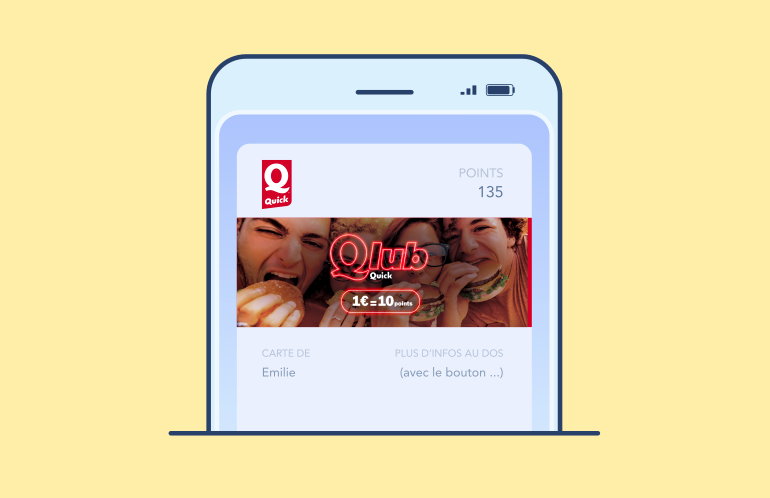
In 2023, the restaurant chain launched its Quick Club using the Splio Loyalty. A simple—yet highly effective—loyalty program. How does it work? It’s a points-based program where customers earn 10 points for every euro spent. The CRM team, however, went all out not only on the catalog of highly attractive rewards (points redeemable for free products, percentage-based discounts, etc.) but also on carefully considering how points are awarded.
In fact, the brand wanted to recognize all actions that contribute to increasing customer value. Here are a few well-thought-out guidelines:
The program’s business objective is clear: to encourage repeat visits to restaurants and promote repeat purchases.
But a program that isn’t part of a broader loyalty strategy generally struggles to gain traction. Quick has understood this well, as the program is the center of attention and is the focus of an omnichannel CRM campaign. In addition to traditional automated campaigns designed to guide the customer’s journey with the brand (developed via Splio Marketing Automation), Quick has opted for wallet push notifications with Splio Mobile Wallets to send short, contextual messages to members who haven’t downloaded the app or enabled app push notifications.
Finally, the teams were committed to offering a mobile experience—a channel that’s now essential. Their goal is to make the app the hub of the Quick experience. And to achieve this, all channels work together! Starting with the loyalty program and the mobile wallet. One of the program’s rules allows customers to earn 30 points when they download the app—a way to reward customer engagement in a different way. And to make things easier, the link to download the mobile app is available from the digital loyalty card in the mobile wallet. A perfect example of app synergies and mobile wallets that brands must embrace!
The results achieved by Quick fully meet the CRM objectives set by the brand when it launched its loyalty program:

With Splio, Quick didn’t just roll out a loyalty program—the brand built a relationship ecosystem designed for the real-world needs of the fast-food industry. By combining a mobile app, a mobile wallet, personalization, and automated campaigns, the brand has succeeded in making loyalty more accessible, more visible, and more engaging on a daily basis. But above all, the brand has succeeded in its goal of encouraging repeat visits and repurchases in a highly competitive industry and increasing customer value!
This strategy illustrates a major shift in customer loyalty strategies : loyalty is no longer based solely on rewards, but on brands’ ability to create simple, seamless, and useful interactions at every stage of the customer journey.
To learn more about our platform, contact us !
Table of Contents