25 Customer Loyalty Strategies for 2026
28
April


Camille Macaudière
Category: Customer Loyalty
April 28, 2026
Customer loyalty is the set of strategies, actions and systems implemented by a brand to create, strengthen and maintain a lasting relationship with its customers , with the aim of encouraging them to come back, buy again, and engage more with the brand.
Customer loyalty has always been the driving force behind brands' CRM strategies . A common thread that has taken on very different forms over the years. In its early days, it was primarily based on a close relationship and tangible rewards. And while these two foundations are still relevant today, a new one has been added: building loyalty in a thousand and one ways, via a multitude of channels .
At Splio, we believe that customer loyalty is no longer achieved solely through a loyalty program. Loyalty is now built through every interaction between a brand and its customers, with marketing automation playing a central role. We’ve identified 25 strategies to build customer loyalty: across all channels, regardless of the customer’s lifecycle, and—most importantly—with or without a loyalty program.
There was a time when the loyalty program was materialized by a paper card , at best tucked neatly away at the bottom of your customers' wallets... and at worst, often misplaced. Like everything around us, digital has taken over our old habits with the arrival of dematerialized cards in the mobile wallets of loyal customers.
Having a digital card offers many advantages for your customers: the card is easily accessible , in all circumstances (no need for Wi-Fi), and your customers have access to their loyalty information in real time , directly from the heart of their smartphone. In other words, loyalty is simplified and much more accessible for your members.
The brand's goal is to democratize this new usage by setting up an email or SMS campaign inviting its loyal customers to download their card into their mobile wallet.
📱 By 2024, there will be no fewer than 13.5 million digital cards in Mobile Wallets of Splio’s client brands.
BANNER
There are several types of loyalty programs , but the most common is the points-based program. The principle is simple: customers accumulate points to reach a certain level and/or reward.
Accumulating points is like a game, where each purchase brings them closer to “winning” (the reward and/or the milestone). This can be motivating for customers who already feel they have invested in the program. They are therefore more likely to continue this commitment rather than lose it, since abandoning it would mean wasting this perceived investment.
By highlighting tiers and rewards in your promotion strategy, your loyalty program points will definitely boost repeat purchases and purchase frequency .
❤️ With its 200 points = €15 rule, 48% of the vouchers unlocked by the Atelier d'Amaya loyalty program generated repeat purchases in 2024 .
Once the loyalty card or dematerialized coupon is in your customers' mobile wallet, a new communication channel opens up to you: wallet push notifications. Unlike emails or SMS, these notifications can't clog up your customers' inboxes and typically achieve higher open rates.
Your wallet push notifications can be personalized based on your customers' purchasing habits (purchase behavior, location, or customer history) or by highlighting exclusive offers.
This channel, if used wisely, can generate more in-store traffic than other channels since there is one object that your customers do not walk around without: their smartphone!
💡 FNAC conducted an A/B test among its customer base. The first group received only the brand’s promotional emails. For the second group, the promotional emails were paired with a push notification summarizing the message. The results speak for themselves: the brand saw a 77% higher conversion rate among customers in the second group!
Gamification is the process of integrating game mechanics into the customer experience to make the interaction more engaging and build long-term loyalty. By transforming loyalty into an interactive, motivating, and rewarding experience , customers are encouraged to return more often and become more invested in the brand.
✅ More fun and engaging experience → Interaction becomes a pleasure, not a constraint.
✅ Strengthening the emotional connection → The game stimulates dopamine and creates an attachment to the brand.
✅ Incentive to action and repetition → Customers come back to progress and earn rewards.
✅ Competition and community effect → Leaderboards, badges and challenges create a sense of belonging.
☕ The loyalty program of the Spanish coffee shop chain GoodNews (also present in France) is primarily based on the principle of gamification with a pool system, regardless of the coffee shop in which the loyal customer purchases their drinks. The result? The average basket has increased by 18% in two months since launch!
Who says loyalty is all about earning points and rewards? Sometimes, loyalty is as simple as handing out a rose to every store visitor on Valentine's Day or welcoming them with a cup of coffee. These small gestures don't cost the brand much but will make members feel special .
By surprising your customers with little touches, you offer them a unique and unusual experience . An experience that will make them want to come back to discover what awaits them next.
🙃 The sales staff at Les Chocolats Alain Ducasse offer customers the chance to taste the brand's latest creations as soon as they arrive in store!
Customer loyalty can't be improvised: it must be continuously measured, analyzed, and optimized . By implementing key performance indicators (KPIs) and tracking tools, a brand can identify what's working, adjust its actions, and maximize customer engagement.
The main reason Retail brands Retail to build customer loyalty is, above all, financial. And the two metrics that best demonstrate the effectiveness of your marketing efforts are: repurchase rate and frequency. The higher these two rates are, the more certain you can be that your customers are loyal to you!
📈 Discover other performance indicators to monitor daily as part of your loyalty strategy in our infographic .

Customers want to feel recognized and understood . And to achieve this, the best way for a brand is to collect as much data as possible about its customers. This data must then be centralized, unified, and synchronized across all touchpoints to become actionable data for CRM teams.
💡 Why not offer a questionnaire to your customers to get to know them better? Quick, inexpensive, and effective, sending a questionnaire of a few questions to your customers would allow you to gain a clearer understanding of their expectations and desires (is your favorite color blue or red?), while developing a sense of closeness and listening.
You collect a multitude of data on a daily basis and via different channels: transactional data, browsing data, preferences, demographic data, etc. The key is to know how to use this data within the framework of your CRM !
This is the whole point of a Customer Data Platform . A tool that, integrated into your ecosystem (CMS, PoS, CRM, etc.), will allow you to increase customer knowledge and leverage your customer data to deploy a unified experience across all channels.
By personalizing marketing campaigns (first name, tailored recommendations, tailor-made offers), the brand shows that it values each customer .
⛷️ Fusalp collects its customers' CRM data in Splio's CDP to personalize its newsletters. The French luxury mixed-gender brand has also noted a 6% increase in newsletter conversions when the content is personalized based on the recipient's gender!

Artificial intelligence is making its mark in our daily lives, and CRM is no exception, particularly when it comes to predictive audiences. Predictive AI analyzes past customer behavior and identifies audience segments with high (purchase) potential on behalf of the brand .
This is also the method chosen by KIABI to improve the performance of its marketing campaigns . The brand faced an issue that manual segmentation could not resolve: occasional customers who returned each year on the occasion of very specific chestnuts, and who were never targeted by campaigns beyond 6 months after their last purchase.
KIABI's CRM teams therefore chose to let predictive AI decide which communications these customers should receive by basing targeting on the data collected and similarities between profiles, going beyond "classic" targeting.
👏 With this switch in the CRM team's habits, KIABI recorded a 10% conversion rate on its newsletters , a result 2% higher than traditional segmentations. And the teams have more time to focus on quality content!
A relative newcomer among communication channels, RCS is becoming increasingly widespread in France, particularly in the Retail sector. What makes it unique? It allows for more engaging, interactive, and immersive communicationthan SMS, thanks to the integration of multimedia content designed to maximize user engagement.
The RCS channel does not require additional consent, it has no character limit, but above all, unlike SMS, it allows brands to access marketing indicators . Indicators which we know are extremely valuable in the management of its CRM strategy.
💡 In fact, Splio has just added the RCS channel to its CRM marketing platform . This will delight the 500 retailers who use our platform daily!
|
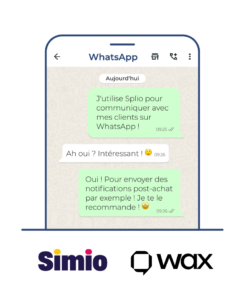
With 24 million users in France, WhatsApp is undoubtedly the most widely used messaging app in the country. Retail brands Retail taken note of this, and WhatsApp is now an integral part of their CRM strategies! WhatsApp has quickly established itself as a strategic channel for retailers , allowing them to communicate with their customers directly via their favorite messaging service. Like emails, WhatsApp messages can be integrated into automated workflows for order tracking, for example. The experience offered through this channel is fluid, direct, simple and interactive: exactly the kind of interaction customers are looking for! Find all the uses of WhatsApp in our blog article . 🆕 Splio has integrated WhatsApp into its marketing CRM platform via its partners Simio and Wax. |
 |
Automated scenarios often get a bad rap. But when they're designed from the start to integrate into a brand's overall CRM strategy and don't add to a brand's marketing pressure, automated scenarios work wonders when it comes to supporting the customer lifecycle !
Several types of scenarios can be set up with various objectives: encouraging repeat purchases , converting a prospect into a customer , avoiding churn , etc. The key is to think about configuring your marketing pressure rules globally and via all your channels so as not to bother your customers.
FAUCHON has chosen to extend the relationship between the customer and its brand after their purchase by developing an automatic scenario based on quality editorial content and personalized according to the purchase (content related to the products purchased).
💌 In fact, 75% of FAUCHON customers who have just purchased caviar click on the tasting tips offered by the brand in its automated email. An excellent score!
Signing up for a brand's newsletter without having made a prior purchase is a first step in consumer engagement. It's a first interaction through which the consumer demonstrates their interest in the brand and its products .
This newsletter subscription must therefore be taken very seriously by the brand since not only does it allow it to acquire the consumer's contact details but it also allows it to detect a potential future customer .
👏 Le Coq Sportif chose to give these interested consumers their full attention by developing an automated scenario for converting prospects into customers. This three-step scenario combines editorial content based on the brand's values with commercial content featuring a promotional code. 57% of the prospects enrolled in the scenario were converted into customers!
Churn (or attrition rate) refers to the departure of customers to one of your competitors or the cessation of their engagement with your brand. The goal of predictive models is to identify at-risk customers before they leave and take action to retain and build loyalty , because it is known that it is more profitable to keep an existing customer than to acquire a new one.
But how does artificial intelligence work to prevent churn?
1️⃣ Data collection : Predictive models rely on historical and behavioral data to detect early signs of churn. Collecting as much data as possible is therefore very important to allow the models to be as accurate as possible.
2️⃣ Identifying weak signals : Machine learning algorithms can detect recurring patterns that indicate a customer is about to leave. For example, a loyal customer hasn't made a purchase in X months or starts looking at cancellation terms.
3️⃣ Deploy targeted retention actions : Once at-risk customers have been identified, you must act quickly to prevent them from leaving. It's important to set up a dedicated scenario for departing customers by offering them personalized content and exclusive offers to encourage them to stay with you.
If predictive models allow you to catch your customers on the fly, it goes without saying that implementing proactive loyalty will always be more beneficial for your brand, particularly by building an engaging and scalable customer experience.
Customer segmentation is a powerful tool for building customer loyalty among Retail brands. By grouping customers based on their common characteristics (age, purchasing habits, last checkout, etc.), it enables brands to better target their marketing efforts andincrease customer loyalty.
Segmentation is beneficial for both brands and customers:
✅ A more relevant message → The customer receives content that corresponds to their needs and desires.
✅ A better customer experience → Fewer unnecessary messages, more meaningful interactions.
✅ A feeling of exclusivity → The feeling of being understood and valued.
✅ An increase in conversion rates → More responsiveness and engagement.
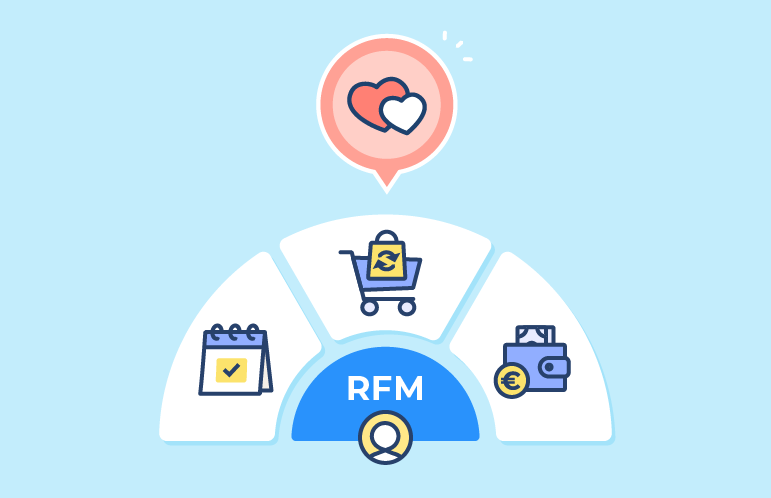
If you were to use only one type of segmentation, it would undoubtedly be RFM segmentation . Based on the recency of the last purchase, the frequency of purchases and the total amount spent, this approach allows for a better understanding of each customer's purchasing behavior, allowing you to steer your targeted CRM strategy on a solid foundation of customer insights.
Personalization takes segmentation a step further, creating unique experiences at an individual level . By leveraging your customers' behavioral and transactional data, you'll be able to anticipate their needs and proactively provide solutions.
The goal of personalization is to create a sense of belonging and increase customer loyalty to your brand. A customer who feels valued by your brand is more likely to remain (or become) a loyal customer, and potentially a brand ambassador.
Personalization comes in many forms when it comes to CRM, but the most common ones would probably be:
🏆 The result of these small actions? An increased retention rate and optimized long-term customer value!

Loyalty often comes through rewards, perks, and special offers , but poorly managed generosity can damage your profitability and reduce the impact of your loyalty initiatives. The challenge is therefore to find the right balance between perceived value and profitability , by offering benefits that build loyalty without devaluing the brand or reducing margins.
Generosity control can be achieved through several points, including:
💶 Two performance indicators should be monitored daily to ensure you are in control of your generosity.
Social media is now a loyalty channel ! On the one hand, it allows for direct, instantaneous, and, above all, two-way interactions . Customers can leave their feedback in comments or express their opinions by liking the brand's posts and stories. For its part, the brand also keeps its menu up to date by quickly responding to comments or private messages. The goal is clear: increase customer satisfaction to strengthen engagement .
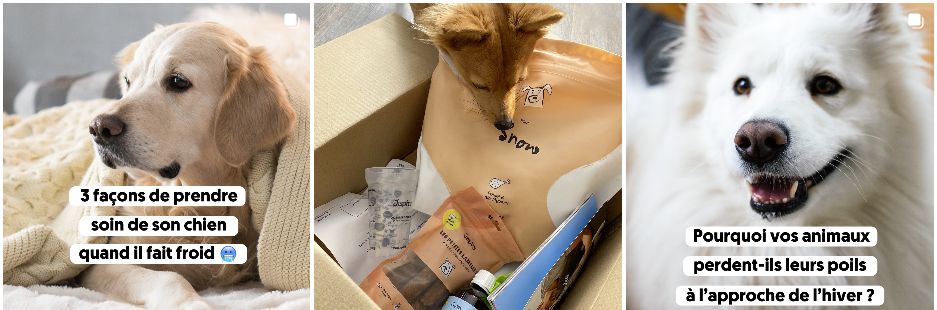
Social media also allows the brand to create a community . A safe place where its customers (and potential customers) come together around a common passion and where the brand provides advice , organizes challenges and highlights customer testimonials . It's a concept widely used by sports brands and pet food brands, like Japhy 👇
Retargeting (or retargeting advertising) is a marketing technique that involves targeting visitors who have already interacted with your brand online . In concrete terms, it allows you to push advertising messages based on the customer's past behavior when they browse other sites.
When a customer visits your website, a tracker (cookie) is placed on their device. This cookie allows us to identify the visitor when they browse other websites, and thus display targeted ads .
Retargeting is particularly effective in two cases:
👑 To be fully effective, retargeting must be combined with your CRM strategy : start by segmenting your audience based on their behavior on your site (abandoned carts, repeat purchases, etc.), then create personalized ads for each segment. For example, you could offer a 5% discount code to customers who have abandoned their cart.
The salesperson is the pillar of in-store customer insights . Customers who visit the store expect an exclusive experience because they can already find everything online. The salesperson is the one who will make this experience exceptional. They are the ones who spend a special moment with the customer, capable of enriching upsell data and customer knowledge with great precision.
This strategy of maintaining a continuous link between the customer and the brand, via in-store staff, is called clienteling.
💡 Clienteling platforms , such as those of our partners BSPK and Digitaleo, exist to help you manage your local communication as effectively as possible.
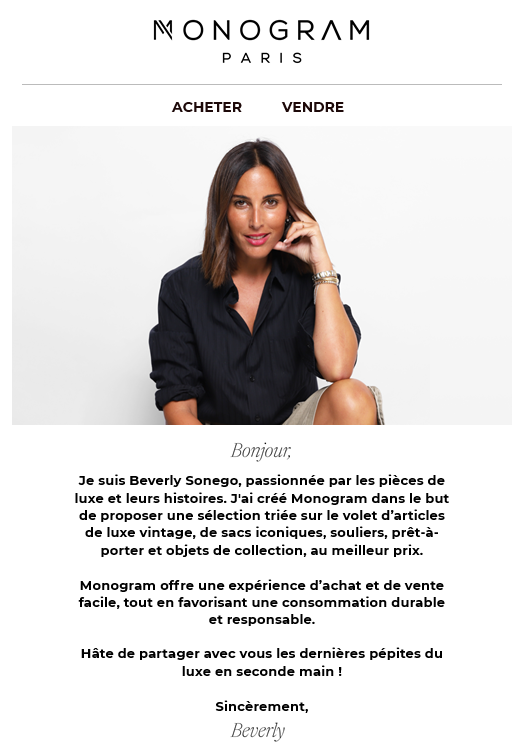 |
Consumers are increasingly seeking authenticity in their relationships with their favorite brands. Giving your brand's founders or employees a voice can be a major asset in increasing your customer loyalty. By sharing their vision, story, and values, founders humanize the brand and create a strong emotional connection with customers . This transparency helps build lasting relationships of trust, where customers feel connected to brands. Giving your brand a face strengthens customer engagement and encourages loyalty. 📸 Take the example of the second-hand luxury goods brand Monogram . The very concept of the brand is based on the personal story of its founder Beverly Sonego, who quickly immersed herself in the world of garage sales and who has a passion for hunting for rare and vintage objects. The brand capitalizes on the founder both on its website with a page dedicated to her story, and through its marketing communications since as soon as the customer signs up for the newsletter, they receive an initial email from the founder. |
Today, customers interact with a brand across multiple channels: brick-and-mortar stores, e-commerce sites, mobile apps, social media, customer service, and more. To effectively build customer loyalty, it is crucial to offer them a consistent, seamless, and frictionless experience, regardless of the touchpoint. This is the very essence ofomnichannel retailing.
But how do you create a seamless omnichannel customer experience, you ask? There's only one possible answer to this question: data . The data you collect about your customers is the key to allowing you to welcome them in the same way regardless of the point of contact.
By unifying your data in a CDP and connecting it with all your points of contact, you give all your teams access to the same level of information:
✅ All data collected in store is sent to the CDP via the cash register software .
✅ All data collected online is uploaded to the CDP via the CMS .
✅ All data collected via your newsletters, your automatic scenarios and your loyalty program goes back into the CDP via your CRM .
And conversely, the CDP allows you to upload all information about a customer (available rewards, online order being delivered, loyalty points, etc.) back into the cash register software to allow your in-store staff to offer them an experience equivalent to that online. And vice versa.
💡 Providing a seamless omnichannel experience also requires real-time inventory management. Is the size of jeans the customer is looking for not available in the store? The sales associate can direct them to another store where they can pick it up, or order it directly online for home delivery. Our partners, OneStock and SoCloz, are specialists in this field!
Today's consumers are more easily attracted to brands that embody strong values , particularly in terms of the raw materials used, their production processes, CSR and the working conditions of their employees.
In the age of social media, brands' every move is scrutinized so that the slightest misstep can prompt customers to withdraw their commitment without warning. Brands must therefore be beyond reproach, both internally and externally.
In order to avoid falling into greenwashing practices, brands must:
🌱 Align their values with the customer experience : The customer experience must be consistent with the stated values by promoting transparency. This is the case for Faguo , which aims to contribute to carbon neutrality by planting a tree for each order placed.
💬 involve customers in the brand's mission: this involves launching collaborative initiatives to strengthen their attachment. This is the case of The Kooples, which offers its "Second Love" platform to give a second life to pieces that customers wish to resell.
The Retail sector can Retail longer rely solely on attractive prices to build customer loyalty. As we’ve seen previously, consumers want to feel included in a brand’s strategic thinking in order to fully embrace it. Today, what sets brands apart is their ability to offer unforgettable experiences that emotionally connect with customers and encourage them to return.
The unforgettable experience is a particularly popular concept in the world of luxury. And this is what our client JOVOY (the Embassy of Rare Perfumes) advocates: exclusivity and experience above all else. At JOVOY, this is achieved through three main points:
✉️ Bringing back forgotten communication channels, especially paper , into fashion. Digital marketing and CRM manager Caroline Capri finds herself imagining scented invitations delivered to homes by hand to provide an exclusive endorsement for a special event or to VIP clients.
🧴 Exclusivity in the products themselves : the fragrances offered by the brand in its Parisian boutiques are not the same as those offered at Harrods or in a boutique in Qatar. Customers therefore have a new experience depending on the country!
🗓️ Appointment scheduling in the spotlight : Caroline Capri explains that allowing customers to schedule appointments via an app has a dual benefit. For them, it's a way to arrive at an ideal time and be greeted by a salesperson who understands their tastes and expectations. For sales teams, it's a way to build a special relationship by welcoming them in the best possible conditions and offering them a highly personalized experience.
Discover other clients' tips for differentiating yourself and making an impression in our Q&A on omnichannel creativity 👇
Building loyalty also involves creating your own chestnut calendar! A special date, specific to your brand, where your customers are king and where you can differentiate yourself in an increasingly competitive market.
Two examples come to mind:
🍪 The first is La Fabrique Cookies' Cookie Day . In September, the cookie brand distributes a free cookie to Parisians (whether they are already customers or not) per visit to the store, whether the customer makes a purchase or not on the day. The brand's objective is twofold: to generate traffic in the store via massive communication on social networks, to acquire new customers via a QR code distributed with the cookie and, of course, to generate additional sales with the free cookie.
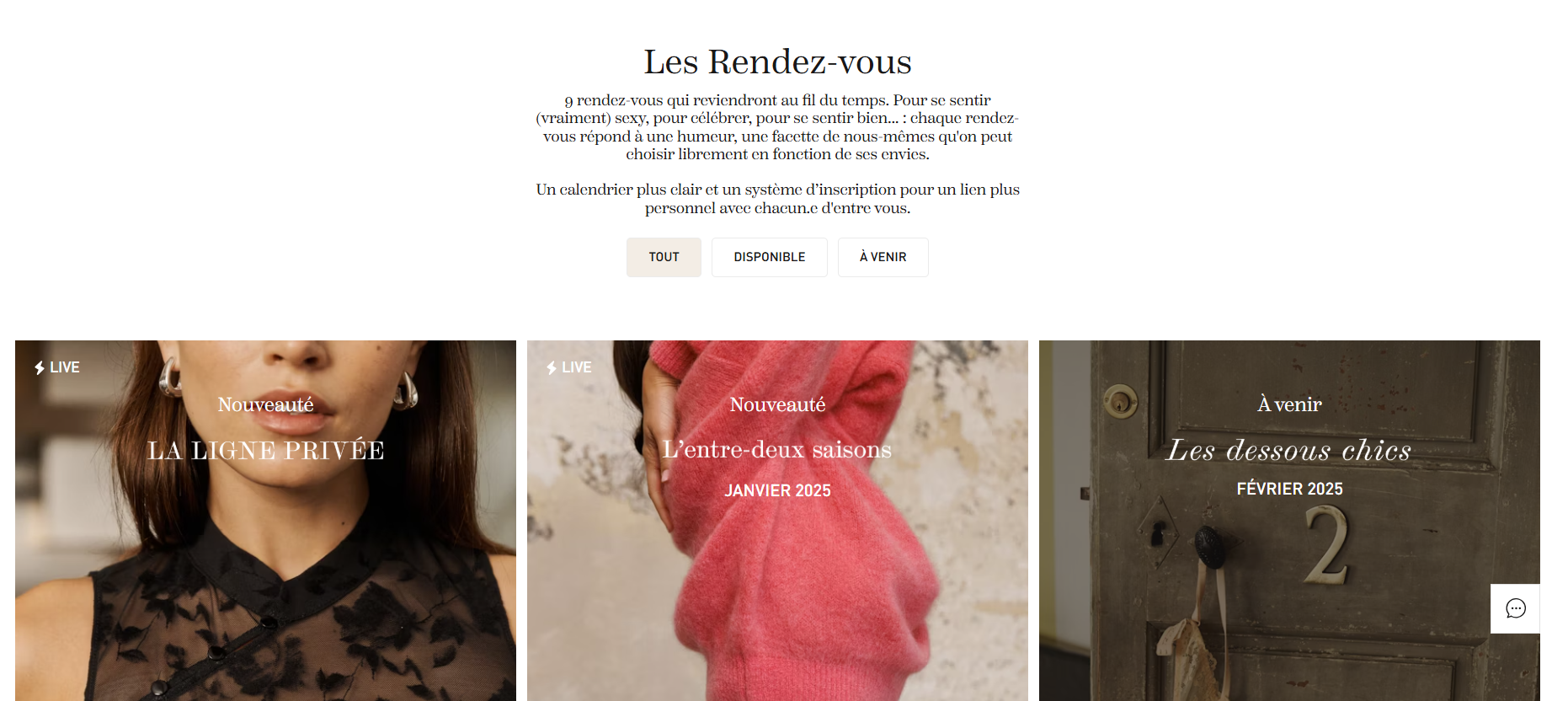
🗓️ The second example is Rendez-vous d’Ysé. The brand allows its customers to follow the launch of its collections via a calendar directly on its e-commerce site, and even to pre-register. The brand’s goal is clear: to create a sense of exclusivity and build anticipation among its customers and visitors to its e-commerce site.
Customer loyalty has a thousand and one facets and can be the subject of inexpensive marketing actions for brands. The trick is to find "that little something extra" that will differentiate your member activities in an original way and make you appear as the leader in your field in the eyes of customers!
Table of Contents
Read also