Mobile apps + mobile wallets: Why brands should no longer have to choose between the two
04
June

Camille Macaudière
Category: Customer Loyalty
💡 Why the synergy between mobile apps and mobile wallets is becoming a key factor in modern mobile CRM
Mobile apps have revolutionized customer relations since 2008 with the emergence of the first modern apps, particularly with the launch of Apple’s App Store. The mobile wallets, meanwhile, emerged in 2012, again spearheaded by Apple, with a different promise: to make mobile interactions more accessible, more immediate, and less cumbersome.
Fifteen years later, however, many brands still mistakenly pit these two channels against each other. Some believe they already have enough channels and that adding a second mobile channel would cannibalize the app. Others prefer to focus their efforts and customer interactions on the mobile app, based on the underlying assumption that the mobile wallet is “less feature-rich.”
According to theINSEE, 84% of French people owned a smartphone in 2025, and 70% of e-commerce transactions e-commerce made via a mobile phone or tablet (Mobile Marketing). These two figures underscore the predominance of mobile devices in the daily lives of the French and show that brands can no longer afford to ignore this trend.
The question, then, isn’t “which channel replaces the other, ” but “how each channel serves a different stage of the customer relationship.” Here are the reasons why you should no longer hesitate to add a mobile wallet to your mobile channels, in addition to your app!
On one hand, you have the app, which serves as your experience hub. Today, the mobile app remains the most powerful channel for delivering a rich, immersive, and personalized brand experience. It allows you to centralize all interactions between a brand and its customers in a single environment. Online shopping, order tracking, click & collect, appointment scheduling, in-store scanning, personalized recommendations, viewing the loyalty program, or even access to exclusive content: the app brings together high-value features that encourage deeper and more consistent engagement.
It is also through the app that brands can build a lasting transactional relationship. Customers can access their purchase history, preferences, and saved payment methods, as well as seamless shopping journeys designed to encourage conversions and repeat purchases.
On the other hand, you have the mobile wallet, which serves as your “always-on” shortcut to the customer. While the mobile app aims to enhance the experience, the mobile wallet excels in another area: accessibility. Adding a loyalty card or pass to a mobile wallet requires very little effort on the customer’s part. No app download, no complex onboarding, no significant storage space: in just a few seconds, the brand gains a direct presence on the consumer’s smartphone. This low friction explains why the wallet is often an excellent entry point for a mobile strategy.
The mobile wallet also benefits from particularly powerful native visibility. Unlike an app that might get forgotten in a folder or deleted due to lack of regular use, a pass wallet remains accessible at all times on the phone and can pop up at just the right moment thanks to location-based notifications, geolocation, or real-time updates. Loyalty cards, coupons, tickets, personalized offers, or contextual reminders can then be viewed instantly, with no effort required from the user. This constant presence allows brands to maintain frequent mobile engagement with their customers to foster loyalty, while expanding their reach beyond just app users.
In conclusion, the app and the mobile wallet are inherently complementary and, each in their own way, support the various stages of the customer journey and help foster customer engagement.
| Mobile app | Mobile Wallet | |
|---|---|---|
| Objectives | Experience & Purchase | Loyalty & Reactivation |
| Target | Highly engaged customers | The entire database, including inactive users |
| Opt-in required | Yes (app notifications) | No (native on mobile) |
| Retention | 25% of apps are deleted after use | 96% retention rate |
| Channel | Push notification app | Push wallet + geofencing |
| Cost | High (development) | Low (fast time-to-market) |
As we’ve seen, the mobile wallet doesn’t compete with the mobile app; on the contrary, it can become a powerful driver of adoption, engagement, and retention. Thanks to its ease of access and high visibility on smartphones, the wallet is an ideal touchpoint for gradually encouraging customers to download the app so they can take advantage of all the mobile services offered by the brand. For example, a brand can directly integrate CTAs such as “Discover the app” or “Activate your benefits in the app” into its digital loyalty card to convert a wallet user into an app user.
This strategy is particularly effective when the app offers genuine exclusive benefits. The wallet pass can thus highlight “app-only” benefits: promotional codes revealed exclusively within the app, early access to drops, restocks, or private sales, or even reserved services such as order tracking, e-tickets, appointment scheduling, in-store scanning, or click & collect. The wallet then acts as a permanent showcase for the app’s added value.
Push wallets also make it possible to deliver highly engaging contextual messages, particularly to drive drive-to-store traffic and re-engage customers through the loyalty strategy : number of loyalty points, changes in the customer’s status within the loyalty program, personalized offers, or time-limited rewards. Some brands go even further by directly rewarding users for downloading the app: a discount on the next retail purchase, a free drink at a fast-food restaurant, welcome perks, or bonus points. This is the case with the fast-food chain Quick, which designed its mobile strategy to offer loyalty points to everyone who downloads the app for the first time.
Finally, to ensure that the app isn’t just a one-time installation, retailers can encourage repeat use through dedicated incentives: double points for purchases made via the app, exclusive benefits, or offers unavailable through other channels. And the logic works both ways: from the app, customers can also add their card to the wallet with a single click to make their experience even smoother and more accessible on a daily basis (without needing an internet connection!).
The rise of predictive AI further underscores the value of combining mobile apps and mobile wallets within a single CRM strategy. Why? Because the more touchpoints a brand has (mobile or otherwise), the more behavioral signals it collects that are useful for understanding, anticipating, and driving the right behaviors. In other words: more mobile channels also mean more data, leading to more relevant predictions and more effective campaigns.
In the context of mobile wallets, predictive models can, for example, identify customers most likely to respond to certain content, offers, or engagement strategies. A brand can thus target profiles most likely to use a coupon, view a personalized offer, return to the store, or interact with a product featured in the wallet pass. Wallet campaigns can be segmented, turning the wallet into a true smart activation channel capable of delivering the right message at the right time to the most receptive audiences.
Predictivepredictive AIcan also be used to optimize new customer acquisition goals on mobile channels. Rather than pushing app downloads or adding a wallet pass to the entire customer base en masse, brands can identify consumers most likely to adopt these features. One campaign can thus specifically target the profiles most likely to download the app, while another will seek to identify the customers most likely to add their card to the wallet. This approach improves marketing performance, customer engagement, and relationship management by prioritizing more relevant and personalized activations.
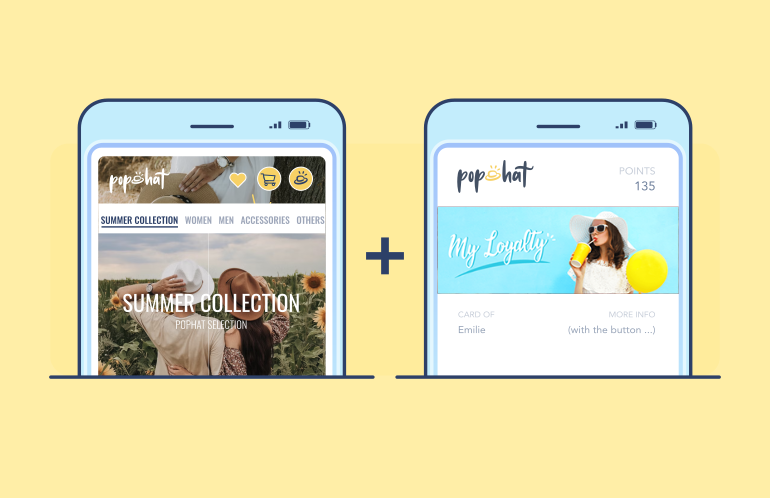
Imagine that one of your customers is window-shopping in front of your clothing store.
In our case, your mobile app would be like a fashion studio and a virtual fitting room. It’s an inspiring, visual, and comprehensive experience. It’s a bit like a fashion magazine, but interactive—one that customers can open from their couch to flip through the lookbook of your new collection, save their favorites, and check if their size is available in-store. In other words, the app is designed to spark desire in customers, help them browse, and put together their next outfit at their leisure.
The mobile wallet would then function like a VIP pass. It doesn’t inspire your customer, but it allows them toact quickly and efficiently. Since they’re near your store, the customer could receive a push notification saying, “Your 15% off coupon is available in-store!” When they reach the checkout, they wouldn’t need to sift through the multitude of marketing emails in their inbox to find that same coupon, since a discreet notification would make it appear with a double-tap on their locked screen. Better yet, they could have reserved an item online and would simply need to present the QR code in their mobile wallet to pick it up at the counter. In conclusion, the mobile wallet eliminates all friction at the crucial moment of purchase and in-store checkout.
In retail, and more specifically in the ready-to-wear sector, the customer journey is often emotional at the beginning and very pragmatic at the end. The synergies between the app and the mobile wallet make it possible to perfectly support this purchasing behavior, starting with the emotional aspect through the app and ending with a very pragmatic purchase via the mobile wallet.
The wallet does not replace the app, and the mobile app does not render the wallet obsolete. The two serve different purposes: the former maximizes accessibility, while the latter provides a hub for the customer experience. Together, these two mobile channels helpexpand the brand’s reach and increasecustomer engagement, strengthen loyalty, and create a much smoother customer experience.
In the age of predictive AI, this synergy becomes even more strategic: increasing the number of mobile touchpoints allows for the collection of more behavioral signals, enabling more accurate predictions and the launch of more relevant, personalized, and effective campaigns.
To learn more about integrating mobile wallets your mobile strategy, contact us !
Table of Contents