Black Friday 2026: Send More or Send Better?
29
October

Camille Macaudière
Category: CRM Strategy
Black Friday is a good indicator of a brand’s CRM approach. Black Friday comes at a time when brands will need to make up for months of sales disrupted by less predictable weather, disrupted sales cycles, more thoughtful purchasing, and purchasing power under pressure. The temptation to communicate more will be strong: more emails, more text messages, more follow-ups, and a greater sense of urgency. Yet it is precisely at times like these that channel orchestration becomes strategic.
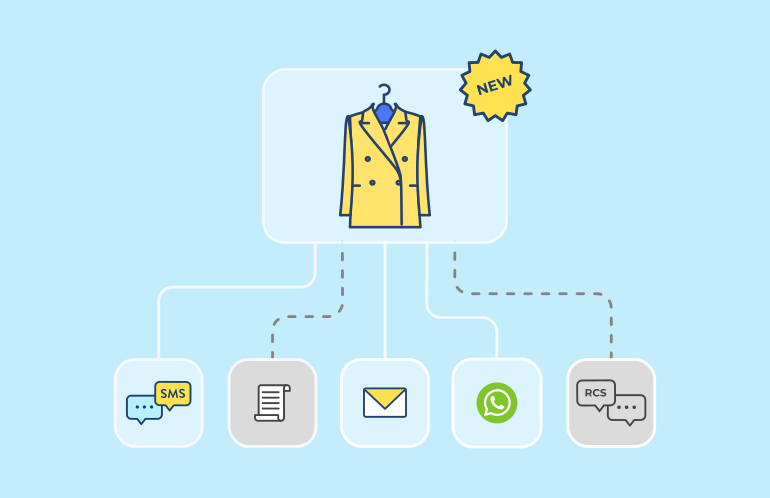
A successful strategy can start with an email to announce the promotion, detail the offers, and prepare the customer base. It can then reserve SMS for the most engaged customers, high-potential “ e-commerce ” shopping carts, or priority drive-to-store audiences; use RCS to highlight a more visual product selection; activate WhatsApp for customers who expect a more direct relationship; and leverage print for loyal, premium, or harder-to-re-engage segments via digital channels.
The question, then, is not which channel to use, but rather which channel to use for which customer, at what time, with what level of pressure, and for what business objective. This is where Splio’s AI is a true game-changer. Not to replace the CRM manager’s expertise, but to help them quickly make the right decisions based on signals that humans cannot always analyze on their own at scale.

77% of French people aged 18 to 64 made at least one purchase during Black Week 2025, according to a Joko study reported by E-commerce Nation.
Black Friday is a great opportunity for customers on a tight budget. With less than a month to go before the holiday season, this wave of sales is more than welcome and gives customers a chance to treat themselves.
But keep in mind that while the number of purchases made by French consumers during Black Friday remained stable (an average of 4.4 purchases over the period), they bought fewer items last year. The fact that the total average basket size per consumer remained at €236 can be attributed to more targeted—and sometimes more expensive—purchases, rather than an increase in the number of baskets. In fact, the average budget increased by only €3 compared to 2024. This modest increase confirms that the shopping season is no longer synonymous with overspending.
The French now view Black Friday as part of a strategic approach rather than a shopping frenzy. Black Week is factored into the annual budget, just like the seasonal sales or Christmas.
These days, as a brand in the e- retail , it’s hard to ignore this major shopping event straight out of the United States. French brands have certainly caught on to this and are rolling out one enticing e- offer after another. The battle to see who can offer the biggest discount kicks off in early November, turning Black Friday into Black Month.
More emails, more text messages, more campaigns—but above all, ever more discounts. The problem is that all competitors are following exactly the same approach. Retailers send out massive mailings several times a month, for fear of missing an opportunity.
The result? Customers’ inboxes are overflowing—across all channels. And brands aren’t achieving their goals: they fail to stand out from the competition, marketing pressure is on the rise, and the customer experience is deteriorating.
"Sending the promotional catalog to the entire customer base" is no longer acceptable in the age of AI.
All brands on the web retail site have the same tools at their disposal during Black Friday: promotions, marketing emails and follow-up campaigns. It’s a tried-and-true strategy, but as we’ve said, it doesn’t allow brands to stand out from the crowd.
Today, the only way to succeed is to be able to identify the customers most likely to make a purchase.
While CRM teams’ approaches remain sound and have proven effective (targeting customers likely to promote the brand, following up with recent buyers, or highlighting seasonal categories), segmentation based on criteria has its limits. Since humans are unable to analyze thousands of signals simultaneously, they are forced to base their segmentations on a set of assumptions.
This is wherepredictive AI comes into play, by identifying the customers most likely to convert in the coming days or weeks. The lens of segmentation is shifting, as we move from an approach based on what customers have done to one based on what they’re most likely to do next. In other words, AI enables the brand to identify the customers in its base with the highest purchase potential so it can prioritize its marketing investments where they’ll have the greatest impact.
In this way, the brand reduces its marketing pressure to focus its communications on customers with whom it has the best chance of achieving its goal: making a sale. Because the key challenge in an era of CRM saturation is ensuring that the actions taken lead to conversion. Contrary to some common misconceptions, predictive AI does not reduce sales opportunities. It reduces unnecessary outreach. Its goal is not to exclude potential buyers, but to identify the individuals most likely to convert. The customers it leaves out are generally those who would not have purchased even with an additional message. Performance therefore does not come from a decrease in marketing reach, but from a better allocation of sales efforts.
“50% off the entire catalog” is not a CRM strategy. At least, in 2026—in the age of AI—it is no longer one.
On Black Friday (or any other recurring sales event featuring promotions, such as seasonal sales or the French Days!), all brands use highly appealing email content.
In fact, this is one of the most ingrained CRM habits that comes up during a sales campaign: focusing solely on promotions. At Splio, we’re convinced that this isn’t enough. Finding the right content—whether it’s a promotion or not—will lead to conversions more easily than simply sending out a catalog of promotions to your entire customer base.
Don’t put words in our mouths, though: products on sale can (and should!) be part of your Black Friday communications. However, they simply don’t need to be the only stars of your November campaigns.
Product recommendations combined with predictive targeting are, in fact, a good way to diversify customer engagement. The brand offers product categories that interest each customer individually, products that are likely to spark their interest, and the offers most relevant to their profile. In this scenario, promotional products become “bonuses” in customers’ shopping carts.
The brand then offers content tailored to customers’ needs and maximizes its chances of conversion. Predictive AI does not limit sales but rather helps expand the reach of communications by adopting the approach that best suits each customer profile, while product recommendations open up new opportunities.
"Sending the same messages across all channels" is not an omnichannel strategy.
Another very common CRM misconception is the assumption that everyone should receive the same message through the same channels. However, some customers respond better to email, while others prefer text messages, WhatsApp, push notifications, or RCS.
Each channel has its own objectives and plays a role in conversion. It must be part of a relevant customer journey and add value to the brand’s results.
During peak sales seasons, marketers tend to send the same message across the various CRM channels at their disposal in the hope of increasing conversion opportunities. This strategy is somewhat counterproductive, as it only increases the pressure on customers. A customer intelligence agent, such as Ask My CRM, is an excellent partner to help CRM teams build a smart marketing strategy. Thanks to its AI-powered analytics capabilities, the agent provides recommendations based on customer data to ensure each channel is used where it delivers the most value.
The brand then implements an smart omnichannel strategyin which each message is carefully selected based on each customer’s preferences. Each channel then fully meets its specific objectives and maximizes the brand’s overall performance.
Marketers’ intuition leads us to use a recurring sales gimmick as a hook to reactivate our inactive customer base. It is believed—and not necessarily without reason—that an enticing promotion will reignite interest in the brand among these customers who are drifting away.
Is Black Friday really the best time to reactivate them?
First, some customers only make purchases on Black Friday. They are, therefore, what we might call “false” inactives who patiently wait until the next Black Friday. This is, in fact, an audience that AI is capable of detecting and including in its targeting strategies.
When it comes to “truly” inactive customers, the question then becomes whether it’s worth putting a lot of effort into reaching them during a period already saturated with your competitors, or whether it’s better to focus on less busy sales periods to re-engage them. And this is where AI is likely the technology best suited to identify customers with the strongest propensity to buy—and thus the highest probability of being reactivated during Black Friday.
As part of predictive targeting, all customers are screened by AI, regardless of their level of engagement with the brand. The audience most likely to engage with the offered content will be identified for targeting and then submitted to the CRM manager for approval. Inactivity should therefore no longer be the sole criterion for segmentation. While purchase history is obviously factored into predictive scoring, other signals (weak signals, scores, data, etc.) are also taken into account to ensure that each customer receives the right message.
Let's stop the "full base" trend, even for Black Friday
Let’s opt for more restrictive but more precise targeting to offer customers increasingly relevant content, thereby truly maximizing our chances of conversion. That’s the whole point of CRM today: sending fewer messages, but better ones— whether it’s the peak sales season or not.
In an era when every brand is speaking at once, what sets them apart is no longer marketing pressure, but relevance. Black Friday doesn’t necessarily reward those who send the most messages, but rather those who can identify the customers most likely to buy, with the most tailored offers and content.
Ultimately, the question is no longer “How many customers can I reach?” but “Which customers am I most likely to win over?” This is precisely where data, AI, and CRM come into their own.
Table of Contents