How Can You Improve the Performance of Email Campaigns Using Product Recommendations?
28
August


Camille Macaudière
Category: Email marketing
💡 A summary of product recommendations in email marketing campaigns
Consumers are constantly bombarded with messages, including in their inboxes. For brands, capturing attention is no longer just a matter of sending a newsletter or a promotional offer: they must also provide content and products that are truly relevant and tailored to each individual’s profile.
That is the whole point of product recommendations. By leveraging customer data and a recommendation engine, brands can personalize the products featured in their email campaigns to improve engagement, click-through rates, conversions, and, ultimately, revenue.
Whether it’s a newsletter or an automated workflow, product recommendations are now an essential tool for delivering a more personalized customer experience and maximizing the performance of CRM campaigns.
In this article, learn what product recommendations are, why they improve email marketing performance, the main use cases to implement, and best practices for turning them into a real driver of growth.
According to a study conducted by Statista, 376.4 billion emails are sent and received every day worldwide Statista. As a result, consumers today are exposed to a large number of marketing messages. To capture their attention, brands can no longer simply send the same content to their entire contact list. Email campaigns must deliver messages that are useful, personalized, and tailored to each recipient’s expectations.
Product recommendations involve including a personalized selection of products in an email, chosen based on each customer’s data and behavior. Unlike a generic selection of bestsellers or new arrivals, these recommendations are designed to maximize relevance and encourage customers to take action.
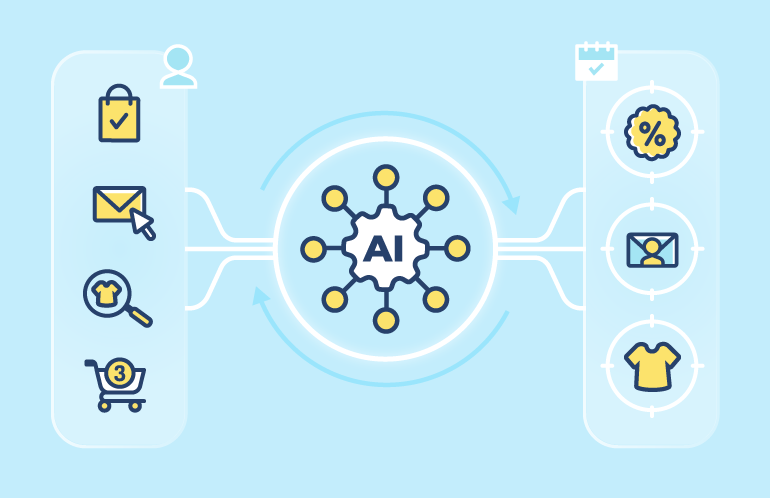
This personalization is made possible by a recommendation engine, which analyzes various data points, such as purchase history, products viewed, preferences, and browsing behavior. Based on this information, it automatically identifies the products most likely to interest each recipient.
When combined with marketing automation, the product recommendation feature enables you to personalize campaigns at scale. Each email can display different products based on the recipient’s profile, context, or marketing scenario—whether it’s a newsletter, a post-purchase email, or a follow-up after an abandoned cart.
When used effectively, product recommendations do more than just enrich the content of emails: they improve their relevance and directly contribute to better marketing performance.
The primary purpose of an email is to capture the recipient’s attention. However, given the sheer volume of messages people receive every day, generic campaigns struggle to drive customer engagement. In contrast, a relevant product recommendation is more eye-catching and naturally encourages clicks.
By highlighting articles related to a customer’s interests, products they’ve viewed, or previous purchases, brands offer content that addresses a genuine need. This makes the email more useful and engaging, leading to higher click-through and conversion rates. The proof is in the latest Splio study on clicks, the click-through rate for emails with product recommendations was 1.5 times higher than for those without product recommendations.
Every purchase represents a new opportunity to engage with the customer. With product recommendations, it becomes possible to automatically suggest complementary items or higher-end alternatives directly in post-purchase emails or loyalty campaigns.
Let’s take the example of a customer who has just purchased a camera. Rather than presenting them with a generic selection of electronic devices, the brand can recommend a compatible lens, a tripod, a carrying case, or even an extra battery. These targeted suggestions facilitate cross-selling and upselling, while providing real value to the customer.
By encouraging cross-selling and upselling, the brand helps increase the average order value per customer. Ultimately, this personalized recommendation is not just a sales tactic, but a genuine source of added value that promotes customer satisfaction and campaign performance.
Product recommendations aren't just about driving more sales. They also help build a more personalized relationshipbetween the brand and its customers.
By taking into account purchase history, preferences, or recently viewed products, each email shows that the brand understands the recipient’s expectations. This form of CRM personalization reinforces the feeling of being recognized and valued—two essential factors for building engagement and encouraging repeat purchases.
Product recommendations thus become a tool for building customer loyalty that enhances the customer experiencewith every interaction.
Finally, a well-thought-out product recommendation strategy also helps strengthen the brand image. The products featured in emails reflect the company’s positioning, values, and brand identity.
A brand committed to sustainability might, for example, recommend eco-friendly products, secondhand items, or durable accessories. Conversely, a premium brand will focus on high-end products or exclusive collections.
This alignment between the recommendations and the brand’s identity helps create a consistent experience throughout the customer journey. Email marketing is no longer just a promotional channel; it has become a true extension of the brand experience.
Product recommendations can be integrated into most email campaigns. Whether it’s a newsletter, an automated email, or a trigger email (triggered by a customer’s behavior), they allow you to suggest more relevant products and improve the performance of each campaign.
Newsletters often feature the same content for all subscribers. By including a personalized product recommendation section, each recipient sees a selection tailored to their purchase history, favorite categories, or recent browsing activity. It’s a simple way to make this weekly update more engaging and increase the chances of conversion.
Automated emails, such as birthday or reactivation campaigns, are key moments in the customer relationship. They offer an ideal opportunity to include personalized product recommendations.
In a birthday email, for example, a brand can combine a promotional offer with products tailored to the customer’s profile. In a reactivation campaign, recommendations can be based on recent interactions or favorite categories to reignite interest and encourage a new purchase.
Emails triggered by user behavior (marketing triggers) are among the most effective in email marketing. This is particularly true of abandoned cart emails and post-purchase emails.
In the case of a abandoned cart, product recommendations help remind customers of the items they left behind while suggesting alternatives or complementary products. After a purchase, they extend the customer experience by offering accessories or related products, thereby promoting cross-selling and upselling.
In the e- retail and e-e-commerce sectors, the cosmetics brand Mademoiselle Bio tested the integration of product recommendations into its email campaigns to improve the relevance of its content and the performance of its newsletters.
The goal of this A/B test was to compare a standard “what’s new” newsletter with a version enhanced with a dynamic product recommendation block based on customer behavior (purchases, browsing, preferences).
The test results show a positive impact on engagement:
This test illustrates the potential of product recommendations in CRM strategies, where email personalization is becoming a key driver of performance.
Beyond the results, this approach primarily serves to enhance the customer experience by offering content that is more relevant and better aligned with consumer expectations.
Implementing an effective product recommendation strategy is not just about displaying products in an email. Above all, it is a structured process that relies on the quality of customer data and the relevance of marketing scenarios.
The first step is to centralize and analyze customer data. Purchase history, browsing activity on the e-commerce website, interactions with emails, and product preferences are all essential signals for powering a reliable recommendation engine.
Next comes the identification of priority use cases. The most effective campaigns are often transactional and automated emails (abandoned cart, post-purchase, reactivation), but product recommendations can also enhance newsletters or promotional campaigns.
The choice of recommendation engine is critical. It must be capable of providing dynamic recommendations calculated daily to ensure the relevance of the products displayed. It must also be directly integrated with your e- marketing automation, as is the case with the Splioplatform, to enable easy activation within CRM scenarios.
Finally, an effective strategy is based on a processof continuous optimization. A/B testing, performance analysis (click-through rates, conversion rates, revenue generated), and adjustments to recommendation rules enable results to be gradually improved.
While product recommendations are a powerful tool for improving the performance of email campaigns, you still need to use them effectively. Here are the main mistakes to avoid.
1. Relying on outdated data. Consumer expectations are changing rapidly. To remain relevant, recommendations must be recalculated regularly to reflect the latest purchases, browsing behavior, or customer preferences. Similarly, you must ensure that your product inventory is up to date to avoid promoting products that are *out of stock*!
2. Limiting product recommendations to newsletters. Newsletters aren’t the only relevant campaigns. Automated emails—such as cart abandonment, post-purchase, or reactivation emails—all offer opportunities to include personalized product recommendations.
3. Failing to measure performance. Like any CRM strategy, product recommendations must be managed using key metrics (click-through rate, conversion rate, revenue generated) and A/B testing to optimize recommendations over time.
Product recommendations are now an essential tool for improving the performance of email marketing campaigns. By offering personalized and relevant products to each customer, brands strengthen engagement, drive conversions, and enhance the customer experience.
To take it a step further, product recommendations can be combined with segmentation generated by predictive AI. By identifying the customers most likely to make a purchase and then presenting them with the products best suited to their needs, brands are rolling out increasingly effective CRM campaigns.
Would you like to learn more about product recommendations or find out how our AI-first CRM platform can help you personalize your campaigns? Contact our experts to discuss your project.
Table of Contents