Marketing Channels and AI: How to Optimize Their Performance in Your CRM Strategy
22
October

Sandra Fernandes
Category: AI for CRM
With Black Friday approaching, here are 7 channels to manage, 5 real-world use cases, and 3 AI tools to help CRM managers drive conversions without overwhelming their customer base.
For a long time, CRM optimization has focused on the message: what offer, what content, what level of personalization, and when to send it. But conversion also depends on other factors, particularly the choice of channel.
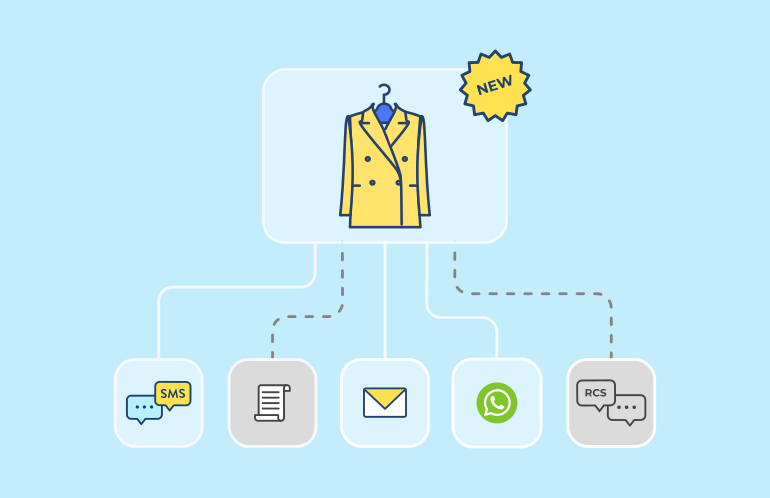
Each channel has its own strengths, costs, attention level, optimal time for use, contact frequency, opt-out risk, and expected business contribution. An Email marketing can nurture the relationship, an SMS can trigger immediate action, an RCS message can enhance the mobile experience, WhatsApp can start a conversation, and print can create value when targeted at the right segment in the right context.
For CRM managers, the challenge is therefore no longer just to orchestrate campaigns, but to decide where to place each message to maximize impact without damaging the customer relationship.
That’s exactly where AI becomes a true co-pilot for CRM managers:
By analyzing customer data, engagement history, purchasing behavior, contact preferences, product interests, and the level of engagement already established with each contact, AI enables more effective management of investment in marketing channels.
For CRM managers and CMOs, the challenge is to increase conversions without overwhelming the customer base, in order to build long-term customer loyalty and retention.
Optimizing your marketing channels doesn't mean choosing between email, SMS, RCS, WhatsApp, print, app push notifications, or wallet push notifications. It means understanding the role each one plays in the customer journey.
Not all campaigns are suited for the same channel. A private sale, a new collection, an abandoned cart follow-up, a loyalty offer, or a reactivation campaign do not all have the same level of urgency, the same acceptable cost, or the same business value.
Predictive AI can help identify not only the customers most likely to respond to a campaign, but also the most relevant channel for engaging them: email to provide details about an offer, SMS to prompt immediate action, RCS to enhance the experience, WhatsApp to build closer relationships, or print to re-engage an audience that is less responsive to digital channels.
The goal is not to use all available channels, but to choose the one that maximizes the campaign’s impact without overusing the most intrusive or expensive channels.
Marketing pressure has always been a key concern for CRM managers. With too many messages, too many channels, and too many solicitations, even the best customers can lose interest if the relationship becomes too intense.
With AI, CRM teams can better gauge the pressure on each contact and decide which campaigns to send, postpone, or not send at all.
There are two benefits: maintaining customer engagement and improving the performance of the campaigns that are actually sent.
Not all customers have the same relationship with a brand. Some regularly click on emails, while others only respond to text messages; some use the app, while others respond better to print communications, push notifications, or loyalty programs.
AI helps us better understand these engagement signals and tailor CRM orchestration accordingly.
The right channel then becomes a tool for personalization in its own right, just like the message or the offer.
Reactivation is one of the most sensitive use cases in CRM. When a customer has not made a purchase, visited the site, clicked on a link, or responded to campaigns for several months, continuing to send them the same messages through the same channels rarely yields better results.
AI can help detect early warning signs of disengagement and select the most appropriate channel for re-engagement.
The challenge isn't to follow up with each customer in a smarter way.
Not all contacts have the same potential. Some customers are high-value, others are likely to make repeat purchases, and still others have a preference for a specific product category.
AI makes it possible to incorporate this business logic into channel selection.
For CMOs, this is a significant change because omnichannel orchestration is no longer driven solely by volume but by business contribution.
The right channel isn't necessarily the one with the highest open rate or click-through rate. It's the one that maximizes conversion at the right cost, without compromising engagement or customer value.
This is especially true for email. The open rate can no longer be considered the primary performance metric, especially when tracking pixels are blocked and their use for personalized optimization requires a higher level of compliance. CRM managers must therefore shift their focus to more robust metrics: clicks, conversions, revenue generated, unsubscribes, opt-outs, repeat purchases, retention, contribution to revenue, and marketing pressure.
The goal isn't just to measure what happened. It's to understand which channel is worth using, for which customer, in what context, and with what expected business return.
| Marketing Channel | Role in the strategy | Priority KPIs | What AI Can Optimize |
|---|---|---|---|
| A relationship- and sales-focused channel, ideal for showcasing an offer, fostering loyalty, presenting a product selection, or guiding customers through the purchasing process. | Click-through rate, conversion rate, revenue per email sent, unsubscribe rate, deliverability, contribution to CRM revenue. | Identify the most receptive audiences, personalize content, choose the right time to send messages, and avoid overwhelming recipients. | |
| Text Message | An emergency and short-term marketing channel, ideal for private sales, abandoned cart reminders, limited-time offers, alerts, or sales events. | Click-through rate, quick conversion rate, cost per conversion, opt-out rate, revenue per message sent. | Reserve SMS for the customers most likely to take action, prioritize taking action, prioritize high-potential campaigns, and limit the use of intrusive channels. |
| RCS | An enhanced mobile channel, useful for creating more visual and interactive experiences with carousels, action buttons, branding, and quick replies. | Interaction rate, button clicks, carousel engagement, conversion, cost per action. | Identify audiences that prefer an enhanced experience, tailor formats, and maximize the impact of mobile campaigns. |
| A channel for local engagement and conversation, well-suited for communications that are anticipated, useful, personalized, or related to a more direct relationship with the brand. | Open rate, reply rate, click-through rate, conversion rate, opt-out. | Identify the customers most open to a conversational interaction and tailor messages based on the customer's context. | |
| A channel for building brand equity and breaking through, suitable for loyal, premium, and older customer segments, as well as those who place a high value on the brand or are less responsive to digital channels. | Response rate, uplift compared to the control group, cost per order, incremental revenue, reactivation. | Select high-value or high-potential audiences to allocate print advertising to contacts where the impact justifies the investment. | |
| Push notification app | An immediate and mobile channel, useful for driving traffic, reigniting engagement, triggering a specific action, or supporting app usage. | Opt-in rate, open rate, click-through rate, post-notification conversion rate, notification opt-out. | Determine the right time, frequency, and audience segment to avoid fatigue and maximize mobile engagement. |
| Push Wallet | A loyalty and drive-to-store channel, useful for keeping a card, an offer, or a benefit readily accessible in the customer's pocket. | Wallet pass add-to-wallet rate, usage rate, in-store traffic, post-notification conversion rate, loyalty program member activation. | Activate the right incentives at the right time—especially near stores—and boost repeat business without relying solely on email or text messages. |
The true value of a customer intelligence specialist isn’t to produce yet another report, but to help the CRM manager understand which channel is performing well, which channel is wearing down the customer base, which segment is falling behind, and which audience deserves an SMS, an RCS message, an email, a WhatsApp message, an app push notification, a wallet push notification, or a print campaign.
By interacting with the CRM data, the agent makes channel decisions clearer, faster, and more actionable for teams. It doesn’t replace marketing expertise, but it reduces the friction between analysis, decision-making, and execution. This is often where the real gains in omnichannel performance begin.