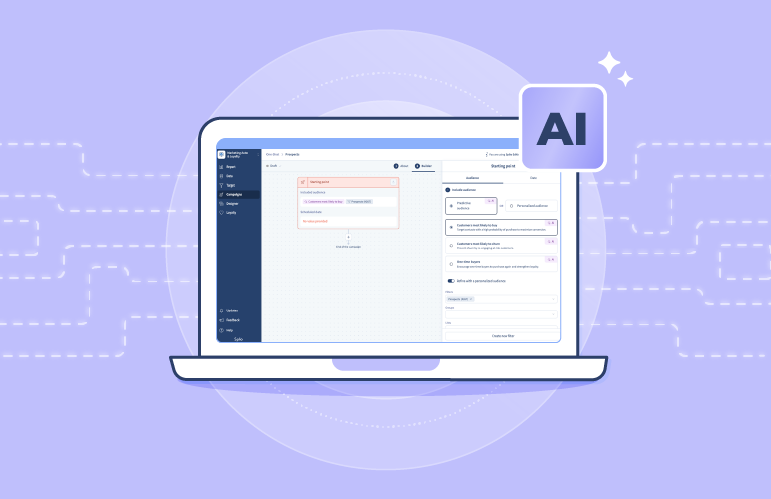
Predicting the Impossible: How Air France Uses Predictive AI on a Large Scale
28
April

Sandra Fernandes
Category: AI for CRM
Deciding when to buy a product is often a matter of statistics. When it comes to travel, however, it’s almost like solving an impossible equation. Every plan to set out on a journey depends on a delicate balance between global circumstances and personal decisions.
For an airline like Air France, which serves more than 170 destinations in nearly 90 countries and carries over 55 million passengers each year, this uncertainty poses a daily challenge. Being present at the right moment in the customer journey with the right message is no longer just a matter of marketing: it requires understanding the customer’s intent even before it materializes into a booking.
Air France’s goal for 2026 is clear: to become the go-to choice for all travel plans. To navigate this complexity, the airline has radically transformed its CRM approach by leveraging the power of predictive intelligence developed by Splio, Tinyclues AI.
Unlike other sectors of e-commerce, the airline industry does not rely solely on repetitive purchasing behavior or regular consumption cycles. Each booking depends on a broader context that goes far beyond the relationship between a brand and its customer.
Airlines operate in an environment that is directly affected by international events. Geopolitical conflicts, airspace closures, or logistical constraints can drastically alter the available options.
For example, avoiding certain conflict zones lengthens travel times and affects operating costs.
In addition to these constraints, there are economic factors—such as inflation, tariffs, and a slowdown in business investment—that directly influence demand. Even the post-COVID recovery has had paradoxical effects: the surge in tourist traffic has been accompanied by delays in aircraft deliveries and maintenance operations, creating unprecedented capacity constraints.
In this rapidly changing environment, the historical customer data that airline CRM teams have traditionally relied on is becoming less reliable for predicting future behavior.
The complexity stems not only from the macroeconomic context, but also from rapidly changing consumer behavior.
Today at Air France, nearly 70% of airline tickets are purchased online, with about half of those bought directly through the airline’s two proprietary platforms (website and mobile app).
Above all, the timing of purchases is changing. Bookings are being made closer to the departure date, which directly shortens the marketing decision window. At the same time, the traditional boundaries between business travel and leisure travel are blurring: certain premium cabins that were previously dominated by business travelers are now attracting more leisure travelers.
Another major trend: inspiration is playing a key role in our database engagement strategies. As Jean-Pascal Amblat, Head of Owned Channels & CRM at Air France, notes , “One in two engagement campaigns is now based on inspiration, without any promotion.” In other words, price alone is no longer enough to trigger a purchase.
As a result, purchase intentions change too quickly to be captured solely through scheduled campaigns. The right message depends on the right moment, not just on a marketing calendar. Prediction specifically addresses this volatility by continuously analyzing customer signals to adapt CRM decisions in real time. As Antoine Scialom, co-CEO of Splio, explains, “Prediction allows us to shift from a campaign-based approach to one of continuous decision-making.”
Given this uncertainty, the challenge for CRM is no longer to segment audiences, butto anticipate intentions. With over 17 million active email contacts, nearly 6 million users receiving push notifications, and more than 100,000 subscribers on WhatsApp, Air France must manage customer relationships on a massive scale while maintaining a personalized approach.
By 2025, 100% of the destinations offered by the airline were covered by Splio Predictive AI, in order to create connections between the brand, its customers, and its prospects, and to engage them through data. Whereas traditional segmentation relies solely on the past, predictive models leverage weak signals to anticipate future intentions (browsing behavior, travel history, loyalty status, or timing of the trip). The goal is no longer just to identify who travels frequently, but to understand:
As part of this initiative, more than 900 predictive audiences were generated. The result? Campaigns targeting these audiences doubled conversions and significantly improved the financial performance of our communications: a 76% increase in revenue generated per 1,000 emails sent.
While predictions may help trigger a purchase, their most strategic impact often occurs after the booking is made. By 2026, nearly 15% of Air France’s revenue will come from the sale of add-on options (seat selection, lounge access, extra baggage, or premium services).
Recommending the right option to the right audience is a complex equation, as it depends on several factors: the status of the loyalty program Flying Blue, the travel class, the original fare, the reason for the trip, and the time remaining before departure.
In this context, predictive AI is essential for analyzing all these variables simultaneously and identifying the right time to take action.
In 2025, this predictive approach led to an increase in revenue from options of approximately 12% compared to the previous year. The conclusion is clear: value no longer lies solely in ticket sales, but in supporting travelers throughout their journey.
For Air France, forecasting is a long-term strategic priority.
One key challenge concerns customer loyalty. Anticipating enrollment in the Flying Blue program would allow travelers to be integrated into the brand’s relationship ecosystem earlier on, thereby providing a better understanding of their expectations and habits. Prediction thus becomes a tool for establishing customer relationships, rather than merely a means of optimization.
Another priority:omnichannel omnichannel. As interactions multiply across different touchpoints (email, mobile apps, or instant messaging), CRM must move away from a “push” approach and learn to orchestrate a “pull” approach, where each interaction is triggered by the right signal at the right time.
Finally, predictive intelligence is beginning to be integrated into conversations powered by generative AI. The Conversational agents are already transforming the way travelers search for a destination, compare different options, or plan their trip, replacing traditional navigation with a continuous dialogue. In the future, predictive capabilities will be directly integrated into these interactions, analyzing cues expressed throughout a conversation, anticipating intentions, and adjusting recommendations in real time.
In an industry as subject to constant uncertainty as the airline industry, forecasting isn’t about predicting the future, but about reducing the unknown.
For Air France, predictive intelligence—powered by the deep learning capabilities of Tinyclues AI—enables the company to align business performance with the customer experience in an environment where purchasing decisions are becoming faster, more emotional, and more context-driven.
CRM is thus evolving into a central role: structuring knowledge, orchestrating interactions, and ensuring consistency in customer relationships on a large scale. More than just a technological innovation, prediction is becoming a driver of sustainable competitiveness. In a world where travel plans sometimes stem from a simple spark of inspiration, the ability to anticipate intent without imposing it may well represent the new frontier of relationship marketing.
Table of Contents
Read also