The Importance of First-Party Data in a Cookie-Free World
18
January 18

Category: Data
A year ago, news broke that sent shockwaves through the online advertising world. Following in the footsteps of Apple Safari and Mozilla Firefox, Google Chrome announced that third-party cookies would be phased out starting at the end of 2021.
Given that Chrome and Safari alone account for more than 80% of web traffic, this change will have a significant impact on online advertising.
Just as when the GDPR was introduced in 2016, advertisers must now take this reality into account and begin to anticipate its implications for their businesses.
So I’d like to share a few points with you that will help you better understand how to turn this challenge into an opportunity for your business.
We will cover the following topics:
In his blog post, Justin Schuh, Director of Chrome Engineering, explains that this decision is driven by a desire to“make the web more private and secure for users, while supporting advertisers.”
Don’t panic: cookies won’t be banned all at once at the end of the year, but advertisers will have to gradually reduce their use of third-party cookies.
In reality, this phased ban will undoubtedly strengthen the dominant positions of major players such as Google and Apple, and indirectly, Facebook and Amazon. They will all continue to track the browsing and purchasing behavior of their logged-in users.
But third-party cookie technologies are putting up a fight. They are reinventing how advertising platforms operate in an open internet.
For example, the Unified ID 2.0 initiative, led by The Trade Desk with support from Criteo, Nielsen, and LiveRamp, uses encrypted and hashed email addresses to create a standardized replacement for third-party cookies.
To what extent will initiatives like Unified 2.0 improve identity resolution (match rate)? Will competing companies be able to reconcile their differences in the long term? Will the user experience be negatively impacted by the constant appearance of opt-in pop-ups?
Many questions remain unanswered.
How should brands respond to this announcement? My answer is simple: I think brands should leverage their first-party data instead of relying solely on traditional players.
In a recent blog post, I explored the data-action gap that all cloud marketing and CDP solutions face.
Advertisers who don’t want to be entirely dependent on Google, Facebook, or Amazon need to start leveraging their first-party data today.
Here is a summary of what I really think.
Marketers shouldn’t have to take on the role of data scientists. They can’t analyze their entire customer databases every time they need to prepare a customer segmentation for a marketing campaign.
As a result, marketers rely solely on the data that is readily and immediately available to them in their day-to-day marketing work.
Problem: This data represents only a fraction of the data available for each customer.
Customer data analysis should not be limited to recent purchases or website visits over the past few days. Segmentation should be able to draw on each customer’s complete profile.
As a result, limiting first-party marketing to remarketing techniques—which focus on customers’ most recent interactions on your site—can quickly become repetitive and even harm customer engagement. These techniques also have limited reach, which in turn can hurt your revenue.
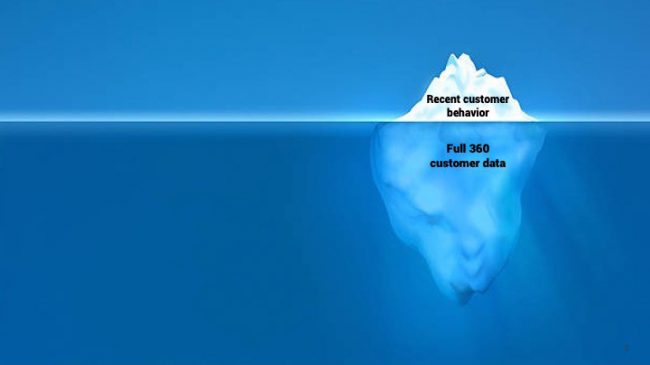
I don't think the problem stems from a lack of data. All brands have been collecting valuable data on their customers for years.
Gender, first name, ZIP code, email provider, purchase history, login history… All this data is stored, and very often goes unused.
Nor is it a technological problem.
Machine learning solutions have made tremendous strides and are now capable of processing massive amounts of data in a matter of seconds. All marketers should be able to process their data independently and tailor their analyses to their immediate needs.
In my view, the real issue in today’s marketing landscape is the lackof autonomy marketers have. Marketers need access to practical solutions that enable themto improve their workflows by fully leveraging the potential of their first-party databases.
That’s exactly what Splio does.
Splio is an intuitive, collaborative tool that enables marketers to intelligently schedule 90% of their marketing messages.
This 90% covers all the business challenges marketers face every day: sales falling short of forecasts, product launches, excess inventory, and more.
In other words, any marketing messages that do not respond to a customer’s recent behavior.
Splio identifies opportunities that marketers would otherwise have been unable to capitalize on by building the best possible audiences, with no volume limits, thereby providing decision-makers with new capabilities.
Its algorithm is powered by anonymized first-party data: CRM databases, online and offline purchases, marketing records, and more…
It also integrates seamlessly with all major CDPs and marketing clouds.
Segmentation based on first-party data is typically used for traditional marketing channels, such as email campaigns, direct mail, or SMS,
However, based on how Splio’s customers use the platform, two additional channels appear to be gaining popularity: push notifications and display campaigns.
When it comes to web and app push notifications, I highly recommend reading this article published a few weeks ago on the subject.
When it comes to billboard campaigns, your first-party data can effectively complement the targeting performed by major advertising platforms, thereby providing higher-quality segmentation.
To run CRM display campaigns, advertisers import a list of hashed email addresses into Facebook Custom Audiences, Google Customer Match, or Criteo Audience Match. These platforms then link these hashed email addresses to their own first-party cookies.
The overlap rate is generally between 30% and 80%.
Once this cross-referencing is complete, it’s relatively easy to set up display campaigns, and the process is similar to what you’re used to when setting up your acquisition campaigns.
CRM poster campaigns can be used in a number of situations, such as:
Facebook and Google offer interest-based and RFM segmentation to help brands with their CRM display campaigns.
But their targeting is broad and unable to provide advertisers with precise customer segmentation.
On the contrary, by analyzing online and in-store purchases, newsletter open and click-through rates, and anonymized sociodemographic data, Splio uncovers the latent characteristics present in each brand’s first-party data.
Splio then dynamically segments these databases based on customers' likelihood of purchasing certain products.
Buying a pair of Nike sneakers is not the same as buying a pair of Gucci sneakers. Generic market segments based on broad criteria such as lifestyle or fashion do not reflect consumers’ actual purchasing behavior.
That is why incorporating insights derived from a comprehensive analysis of first-party data can be a crucial addition to the basic targeting offered by Facebook, Google, and all other advertising platforms.
By going beyond interest-based targeting, lookalike audiences, and remarketing, Splio significantly improves the performance of display campaigns targeted at specific customers: higher conversion rates, lower cost per sale…
Leveraging the implicit information shared between a brand and its customers is essential for meeting those customers’ needs while optimizing marketing budgets.
This implicit information helps strengthen customer relationships and maximize retention potential.
After all, that’s what it really comes down to: improving customer loyalty by knowing your customers inside and out and making them feel special.
This is the key to making the most of everything you know about your customers.
Table of Contents