Last year, Splio published this infographic, discussing the incredible growth of Black Friday for European retailers and e-tailers. The 2017 edition of Black Friday was a real success in Europe, but it doesn’t follow the same format or have the same objectives as in the U.S. Here, we’ll take a look at what conclusions can be drawn from 2017, what the plans are for 2018, and which strategy to implement for November.
2017 Black Friday – Drawing Conclusions.
European brands have successfully capitalized on Black Friday, and you’ll need to take these points into account for your 2018 strategy:
- Does Black Friday only take place on November23? Last year, the sales lasted 8 days across all sales channels!
- Online or offline? Both! Black Friday is omnichannel. Retailers and e-tailers can direct traffic to just one of their sales channels or to both their website and physical stores. The website Black-Friday.sale reported a 30% increase in online sales and a 33% increase in overall sales for the 2017 event.
- Black Friday for retailers and Cyber Monday for online retailers? The one and only seasonal event for everyone! Black Friday has taken over Cyber Monday, creating a week of promotions.
- Just another promotional week among many? Not quite. Black Friday is the perfect opportunity to kick off the end-of-year sales season on the right foot. You just need to incorporate it into a clear purchase funnel leading up to the 2019 winter season.
2018 Black Friday rule: “Surprise me!”
"Promotion" isn't necessarily a bad word, and it doesn't have to involve outrageous promotions. Black Friday isn't (in Europe) synonymous with keywords in all caps, spam, and fluorescent yellow billboards. It's up to you, marketers, to create your own Black Friday, to take it to the next level, and to craft a seasonal event that makes sense for your brand, your customers, and your prospects.
Give your promotions meaning! Black Friday is a seasonal event that attracts customers mainly because it revolves around promotions. But what kind of experience do you want to offer your customers during this time? Your strategy this year will be to give your promotions meaning by communicating your positioning and your philosophy about Black Friday: create an event— one that’s uniquely yours.
- What is your client philosophy for Black Friday? Don’t forget that it takes place right after Thanksgiving in the U.S., a time for family gatherings. Is this the right time for your clients to enjoy it? To surprise their families? To start thinking about Christmas now to make this moment even happier and more meaningful?
- What is your brand's positioning? Is it time for you and your brand to communicate a value you care about and use Black Friday as a platform?
- What if you focused on giving back and doing good deeds during Black Friday 2018? As we know, Black Friday falls on the day after Thanksgiving. But it also takes place one month before Christmas. To give your Black Friday a meaningful purpose—while still taking advantage of the sales—you could consider making small donations and partnering with NGOs. A Black Friday dedicated to solidarity or charity? That’s a commitment that’s sure to appeal to Millennials and give you the opportunity to launch a PR campaign.
Gain or retain customers with Black Friday? Both ! Take advantage of Black Friday by launching both a loyalty campaign and an acquisition campaign, using these two segments to segment your database. Use a transactional tone of voice when communicating with your prospects and a relational one when communicating with your loyal customers.
- A campaign visual that captures your readers’ attention, an overarching theme, and a great personalized message for each person. Then, thanks to your knowledge of your customers and personalization, you can use this event to invite your loyal customers to your store or online shop and offer them a promotion on a product they’ve previously shown interest in.
- Offers for everyone and personalized attention for your loyal customers and brand ambassadors, thanks to the buzz you’ll generate around Black Friday, the unique experience you’ll provide on your e-commerce website, or the retailtainment events you’re organizing at your busiest store.
So what's the schedule for Black Friday?
Start your communications in early November, right after Halloween, and implement a regular omnichannel communication strategy, beginning with a weekly email, in line with the special strategy you are planning for Black Friday.
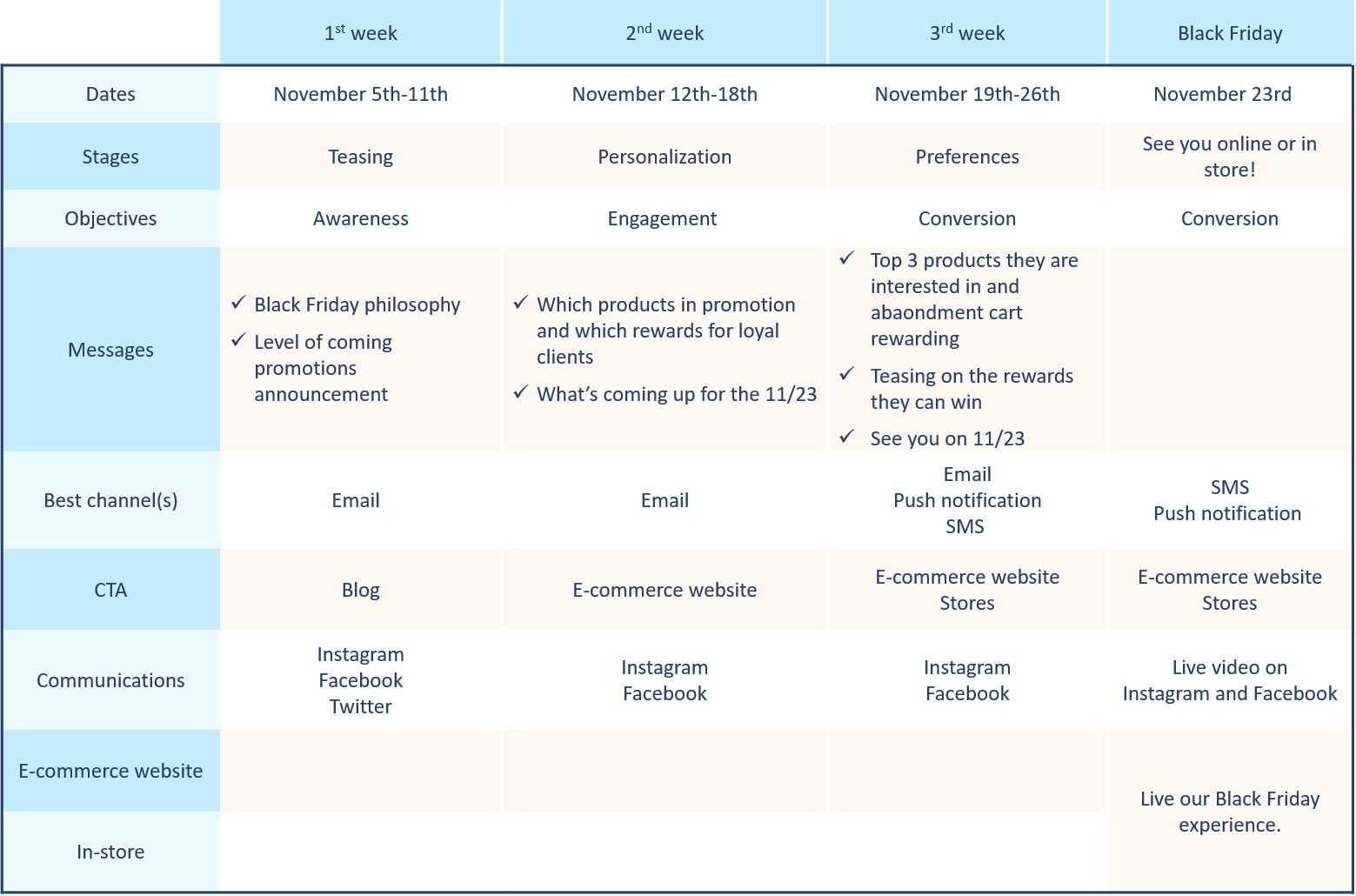
- First week:
- Starting November5, get your clients and prospects excited by announcing Black Friday week and what you’re planning to do on November 23.
- An email with a real-time countdown (the countdown updates every time the recipient opens the email) would be a good way to pique your readers’ curiosity.
- This might also be a good opportunity to explain your philosophy regarding this busy time of year: Is it a time to enjoy yourself, or to make the people you love happy?
- Second week:
- Customize your messages based on your knowledge of your customers and the analysis you conducted after your last email campaign.
- Offer seasonal recommendations, suggest a gift they might like based on their purchase history, and recommend a good deal for their relatives.
- Third week:
- Analyze the open and click-through rates from your previous campaigns and highlight the top 3 products that customers are interested in, giving them the promotion they deserve.
- Think about gifts for loyal customers—a little Black Friday bonus.
- Encourage people to visit the website or come to the store!
- November23:
- Today's great deals.
- Share updates about your event online or in-store!
- Until Cyber Monday, give your customers access to the last great deals.
Black Friday may be the perfect opportunity for your brand to stand out in a competitive market while keeping your conversion, loyalty, and sales goals in mind.
Have a great sales period!