The Customer Lifecycle in Retail
December 4
December
Category: Customer Loyalty
From the moment a potential customer first discovers your brand until the moment they make a purchase, they go through several stages. We refer Retail this process Retail the Retail customer lifecycle. It’s essential to understand each stage of this funnel so you can tailor your marketing strategies accordingly.
In this article, we'll go through each of these steps and how to approach them to maximize your results.
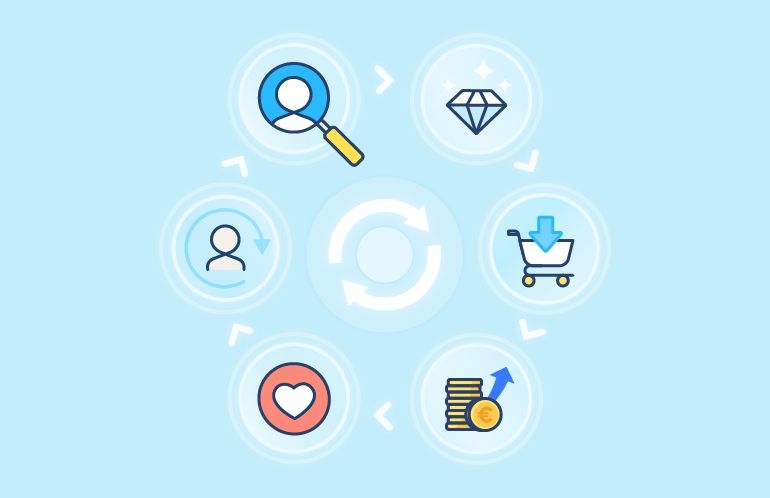
The customer lifecycle represents the journey a consumer takes. In the Retail industry, this journey begins when a customer discovers a product and ends when they stop using it. This concept is fundamental in marketing for optimizing your actions and content at each stage.
But then, what are the different stages in the retail customer lifecycle? The classification we propose in this article is not the only way to proceed. There are less complex classifications consisting of just four stages: introduction, growth, maturity and decline. The structure we've chosen for our article obviously encompasses all four phases, as well as a few others.
The customer journey begins when the potential customer first comes into contact with the brand or product, whatever the channel. The main aim of this stage is to arouse the customer's curiosity and encourage them to want to know more.
The main aim of this stage is to capture relevant consumers and gather as much information as possible about those interested in the product or brand being promoted. Retailers have various channels at their disposal, but online advertising campaigns (Google Shopping Ads, Instagram Ads...) are particularly effective today in targeting consumers most likely to make a purchase, thanks to similar audiences ("lookalike").
The challenge when introducing a product or brand to a consumer is to get them to consider the product or brand as a possible option, and thus move on to the next stage in the lifecycle.
With the multitude of products available on the market, the potential customer will naturally ask the question: "Why this company/product rather than another one?". The challenge of the consideration stage for your brand is to help them distinguish between the different products by highlighting the advantages you offer over the competition.
Here are some useful resources to create for this phase:
By providing relevant information and personalizing each of your interactions as much as possible, you push the customer further along the lifecycle, gradually leading them towards purchase.
It's that long-awaited moment in the life cycle: the purchase.
To help achieve this stage, it is essential to :
It's also crucial not to let potential customers slip away along the way. That's why effective tactics such as setting up automated scenarios in the event of shopping cart abandonment or navigation scenarios are recommended.
These days, personalized attention is primordial, and part of that personalization can be delivered with the help of artificial intelligence (AI). For example, a chatbot can be integrated into e-commerce to answer customer queries around the clock. However, it is important to combine AI with human intervention at key moments in the customer relationship.
One of the most important customer lifecycle indicators in retail is the average cart value per customer. A customer who buys just one product is not as "profitable"as one who buys several. This is why the growth stage aims to increase market share.
Two strategies are proving effective:
For example, in a women's ready-to-wear boutique, after having sold a bag to a customer, upselling would consist in offering her a better-quality bag from a more prestigious brand. Cross-selling, on the other hand, might suggest a jacket or dress to match the newly acquired bag.
In short, this step is designed to stimulate a sustainable increase in purchases.
The success of a customer’s lifecycle depends in part on maximizing its duration. It is well known in the Retail industry Retail retaining a customer is far more profitable than attracting a new one. In fact, according to the Harvard Business Review, it costs between 5 and 25 times more to acquire a new customer than to retain an existing one.
At this stage of maturity, customers are already committed to your company and appreciate your products. The challenge is to encourage regular purchases, while keeping your brand in the customer's mind. So, as soon as a need arises again, the customer will think directly of your brand.
To meet the challenges of this stage of the lifecycle, companies can set up loyalty programs, for example with Splio Loyalty. An omnichannel strategy is also highly recommended for these marketing initiatives.
A digital loyalty card via Mobile Wallets is an excellent solution. On the one hand, it allows customers to always have their loyalty information and coupons at their fingertips. On the other hand, it enables retailers to open a new communication channel using push notifications to continue nurturing that relationship.
If all goes well, customers will remain loyal over the long term, gradually strengthening their commitment to the brand.
But if things don't go well, a phase of decline occurs: the customer loses interest in your brand and your products. How can you regain their attention?
It's a good idea to think about reactivation scenarios by combining various digital marketing strategies. Sending marketing emails with coupons, competitions or prize draws can be one of the solutions adopted. You can also consider anniversary campaigns or milestone events, such as the anniversary of the first order, to rekindle the relationship.
The aim is to relaunch communication in a personalized way, tailored to the customer's specific interests.
In short, Retailers need to keep in mind that keeping the customer in a favorable buying lifecycle is a long-term task. Here are a few key points to always bear in mind in your marketing actions:
The real challenge of customer marketing lies in customer engagement, repeat purchases and loyalty. This is what will guarantee your company's survival and growth!