The Marketer’s Guide to Creating CRM Audiences: The Benefits of Plug-and-Play Deep Learning Solutions
10
December
Category: AI for CRM
Have you ever questioned your team’s CRM audience creation process? Have you ever wondered if your audience creation criteria were specific enough? Or how it could be so time-consuming and tedious to generate your segments? Or perhaps you’ve simply asked yourself: in 2021, is there really no better way to do this?
Or perhaps you currently only send out mass newsletters, but are planning to adopt a more targeted approach soon? This project raises a dozen or so questions, including data processing, audience creation, and internal resources…
Or maybe you’re just curious to learn how AI works in the field of B2C CRM marketing?
Whatever the reasons, I’m here to help. In this illustrated guide, I’ll explain, step by step, the limitations of traditional audience-building methods and show you why deep learning is the only way to effectively build a CRM audience (as well as a few other practical applications in the field of CRM marketing!).
But first, a quick note: this article is a bit long.
To begin with, it is important to establish a few definitions, as companies tend to use different terms for different types of CRM communications.
CRM communications generally fall into one of these categories:
Today, we’re going to take a closer look at these targeted campaigns. They account for about 90% of the CRM messages sent by a brand. They are used to promote new collections or products, sales, specific product categories, and more…
Generally, CRM teams start by sending batch and blast campaigns to their entire customer base. However, they usually quickly realize the limitations of this type of campaign:
So, naturally, you’ll want to move on to targeted campaigns focused on specific topics or offers to share with a small segment of your customer base that is particularly interested in what you have to offer.
Why do CRM teams run targeted campaigns? There are many reasons:
To achieve your goals, your targeted campaigns must meet one key requirement: they must be as relevant as possible.
And their success hinges on the assumption that your CRM team will be able to identify, for each targeted campaign, the customer segment most interested in your campaign.
So how do you make a campaign effective? For each targeted campaign, a CRM team must identify the customer segment that will be interested in the campaign’s topic(s), engage with it, and ultimately convert.
Does that sound easy? Think again.
As marketers, we’ve all learned to segment our market and categorize our customers into clearly defined groups. It’s become such a habit that we sometimes forget our customers are real people, in all their complexity, with their desires, their quirks, their ideas, their spontaneity—in short, everything that makes them human.
The best among you might not forget… but what options do you have left?
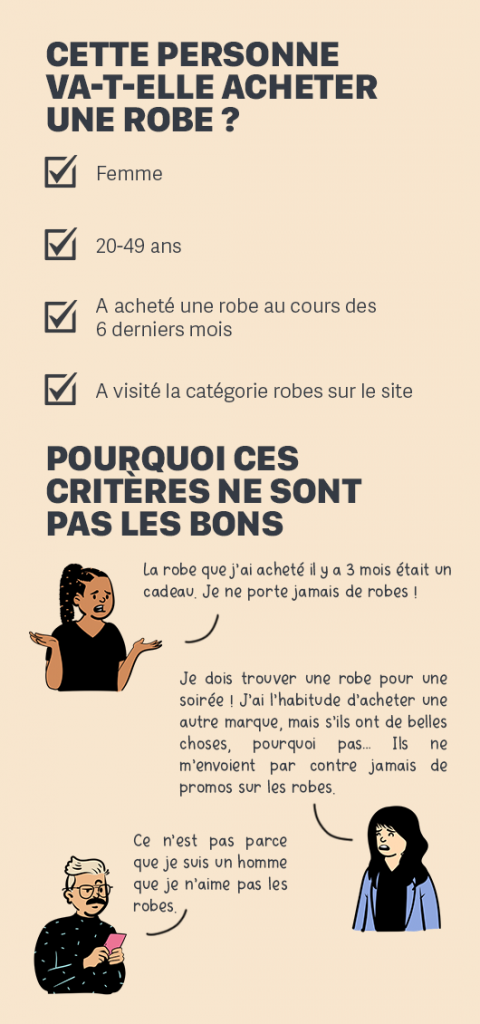
Traditional segmentation tools are based on assumptions that shape the audiences they create.
In practice, here's what it looks like:
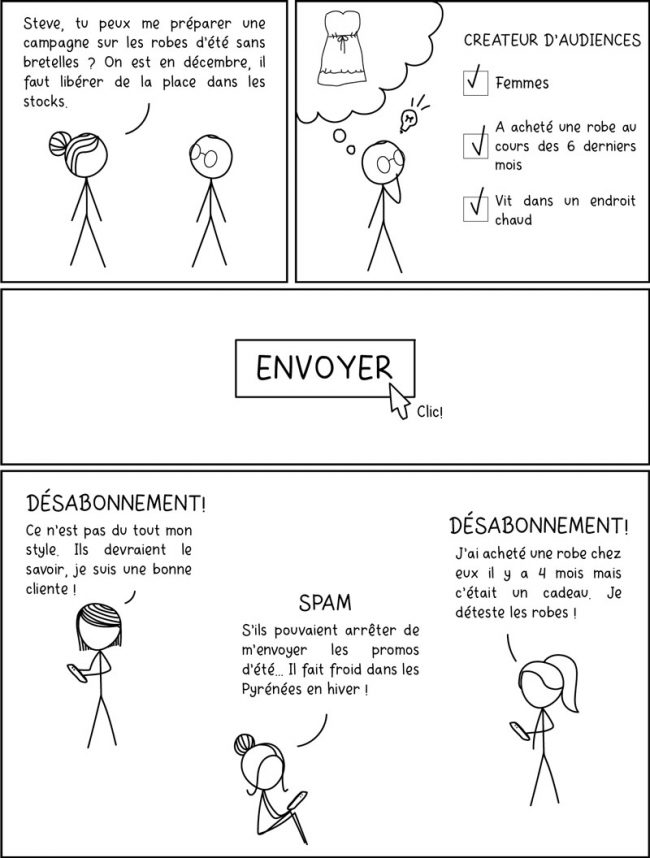
Of course, that’s a bit of an exaggeration. I hope this little comic book campaign will still manage to generate sales. But I’m sure you get my point. The traditional approach to campaign targeting, based on a set of assumptions, has many flaws.
The first-party data in your CRM database is undoubtedly very rich. You have so much data on your customers, their behavior, and your products.
And yet, when you build audiences using the method described above, a twofold simplification takes place, one that is generally driven by your assumptions:
For these two dimensions and these two values, your parameters will be guided by intuition (at best) or by your assumptions (at worst) and will therefore always be influenced by your personal biases.
So, you can probably guess what I'm going to say next…
Because this method is only a very rough attempt to " predict " the effectiveness of your campaigns:
Unfortunately, using purchase history to predict future purchases will lock your customers into their initial categories, and you’ll miss the opportunity to show them additional offers—even if those offers might be relevant to them.
One of the pitfalls of adding too many criteria to refine your audience is that it can end up being too small. Marketers often realize that their final audience is too narrow. They then have to make compromises—adding new segments, removing certain criteria—only to end up back where they started: with a broad, poorly defined audience.
When you create an audience, it’s not enough to predict its likelihood of purchasing a specific product. You actually need to predict its likelihood of purchasing at the time the campaign is sent.
It’s not enough to say, “Steve has bought a dress in the last six months, so Steve will probably buy another dress someday,” to include Steve in your dress campaign. Over a very long period of time, that statement is likely to be true, but it doesn’t really help with the campaign you need to send out tomorrow.
It would be much more effective to be able to say, “Steve is very likely to buy a dress this week, so let’s include him in tomorrow’s campaign.”
I hope we are now on the same page regarding the limitations of traditional audience-building methods.
Fortunately, there is a solution, and that is, of course,artificial intelligence.
More specifically, deep learning.
When you think about it, it makes sense:
You might be wondering what the connection is between building an audience and image recognition. Here it is:
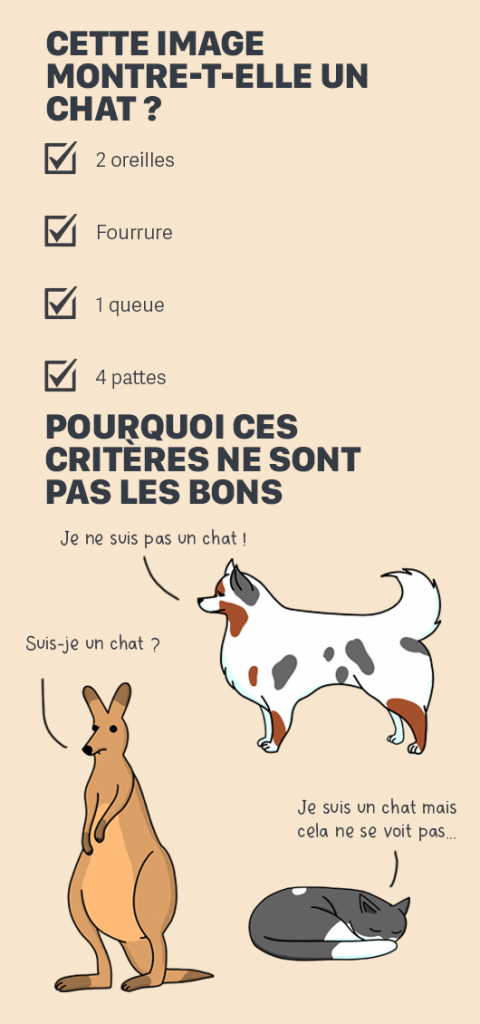
5. However, in both cases, it is possible to find a large number of examples where the question has already been answered.
We know that deep learning works surprisingly well for image recognition. With a sufficiently large dataset to train the models, the success rate is close to 100%. For certain specific applications (medical imaging, for example), deep learning models are already more effective than humans!
Deep learning applied to image recognition (and in general) works much like the human brain: just as a child learns to recognize a cat, not by memorizing a list of criteria provided by their parents, but because their parents patiently show them pets and tell them, “This is a cat,” “This is a dog.”
Deep learning applied to CRM works in much the same way. The algorithm will base its learning on your entire database—that treasure trove of first-party data we’ve already discussed—without excluding any data points or getting bogged down by arbitrary rules. It will incorporate all edge cases that your intuitive criteria could never have identified and take them into account to adjust its predictions.
The deep learning algorithm will be able to detect highly nuanced data—such as product lifecycles, seasonality, people’s “styles,” and their “unpredictability” —even though none of these factors are explicitly recorded in your database.
Deep learning can accurately predict that Marie will buy a vintage floral dress, even if she’s never bought a dress from you before—or any“vintage”or“floral”items, for that matter.
Of course, everything I’ve just mentioned applies only to a well-designed deep learning algorithm. Simply feeding CRM data tables into an image recognition algorithm won’t be enough to generate predictions about purchasing intent.
Similarly, we all know that artificial intelligence and deep learning are buzzwords. So here are a few things to keep in mind when considering how to incorporate artificial intelligence or deep learning into your CRM strategy (!):
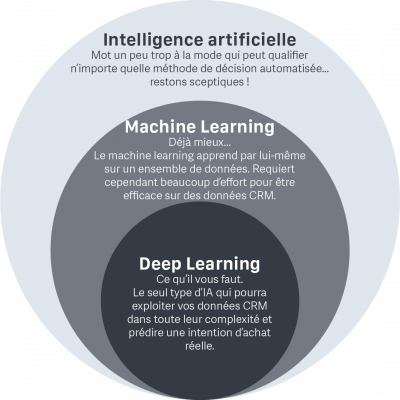
Bingo! It seems that deep learning is the most suitable form of artificial intelligence for predicting purchase intent.
There are still a few key questions regarding deep learning:
As is often the case, the true value of an algorithm lies in its application and execution. That is why manydeep learningmodels are available for free or sold commercially. While these serve as excellent foundations for your algorithms, they won’t get you very far in your day-to-day work.
That’s also why, in general, you should be wary of AI, machine learning, or deep learning applications that weren’t developed for a specific purpose, but rather for a wide variety of use cases. Einstein, Watson—do those names ring a bell?
Not all AI or deep learning models are created equal.
For deep learning to be successfully applied to building CRM audiences, it must follow certain basic principles:
Without these two qualities, an app would never be used.
Here are some key points on the effective use of deep learning in CRM:
All of these points seem pretty obvious, which is exactly why these applications are called “solutions” and not “problems”! But you might be surprised by how many “solutions” don’t meet all three of these criteria.
***
That being said, let's get down to business.
That their data is still not“clean”: consistent, organized, and usable.
No, there is no such thing as“clean”data.
We have to live with it and still deliver the results that are expected of us. The good news is that this is entirely achievable if the model was developed with this constraint in mind.
It’s pretty obvious, both in terms of effectiveness and practicality. Marketers want to see results from day one—that’s non-negotiable. Deep learning models must therefore be able to learn from historical data and have high predictive power right from the start. (To learn more, read the article by one of our data scientists—it’s a bit more technical than what you’re reading now, so you’ve been warned!).
It’s mainly a matter of effectiveness: if these trends and behaviors aren’t reflected in the predictions, the results will be mediocre at best. Shopping habits are very different during the holiday season and in early spring, for example!
To better account for seasonality, the model must be calibrated to give special weight to the most recent purchases of the product for which it is predicting purchase likelihood!
Revenue, in most cases, rather than open rates, click-through rates, etc.
In any given week, perhaps 2% of your customers will visit your website or make a purchase, generating new data points.
And over the course of 3 or 6 months, maybe you’ll reach 20 or 30% of them?
But what about everyone else—the vast majority of your customers—for whom you don’t have recent data? You’d still like to be able to send them relevant communications. They may even be inactive, making their reactivation all the more necessary. This is the shortcoming of many personalization or product recommendation solutions: they work well for customers whose intent data is very recent, but are completely ineffective for everyone else.
After all, very few of us buy only dresses, only rugs, or only flights to Miami. If Jean has already bought socks from you, are you going to send him only sock-related promotions? If Marie has stayed at your hotel in Bordeaux in the past, is she doomed to receive your “Weekend in Bordeaux” offers forever? What if Marie doesn’t like visiting the same place twice?
***
As we’ve seen, developing a deep learning model designed to predict purchase likelihood based on a CRM dataset raises many questions. In fact, there are so many that it’s never worth it for a company to build its own model in-house: the level of expertise and development time required would likely deter most companies…
However, for a team of data science experts whose sole focus for years has been to create and refine such a model, it is possible! And this research has many practical applications in the field of CRM marketing.
The practical applications of being able to accurately predict each customer in your database’s likelihood of purchasing a product or offer from your catalog are endless. Here are a few:
The first practical application is, of course, building an audience (as you might have guessed, that’s the topic of this article).
Let’s say your deep learning algorithm can rank all your customers from most likely to least likely to purchase a given product. In that case, creating the audience could simply come down to:
CRM teams send out numerous campaigns every week, sometimes several a day. However, they may have a policy stipulating that no customer should receive more than three messages per week, or more than one message per day.
But what happens if a customer is highly likely to purchase every single product featured in the campaigns scheduled for the same day?
Information regarding purchase propensity could be used by the algorithm to assign this customer to the campaign where their purchase propensity will be highest, thereby ensuring maximum relevance of your messages while minimizing customer fatigue.
If you can calculate a customer’s propensity to purchase a product, there’s no reason why you can’t calculate a customer’s propensity to purchase a product through a specific channel.
This adds a whole new dimension to everything we've discussed so far!
There may be a small group of your customers who are particularly fond of a certain product right now. They won’t show up in your key metrics because the product isn’t yet among the “best sellers ”… but there is strong demand concentrated among this small group of people. This is the ideal audience for a targeted CRM campaign!
This information could, for example, be used to create a heat map of your product catalog, allowing you to easily visualize all these opportunities.
Should we highlight two products in the same campaign or in two separate campaigns?
The answer depends on whether people interested in one product will also be interested in the other.
Guess how to get that information…
If you've made it this far in the article, thank you! I hope you've learned a lot from it.
If you’d like to learn more, feel free to check out all our articles.
Table of Contents