Boost your email click-through rate with predictive AI
09
April


Sandra Fernandes
Category: AI for CRM
In 2026, the click in my email will be more critical than ever. It is a direct signal of relevance, an indicator of interest, and often the tipping point between a CRM strategy that nurtures the relationship and one that alienates customers. The email click-through rate remains one of the best proxies for the quality of the relationship because it measures genuine interest, reflects the relevance of messages, and directly influences performance attributable to CRM.
But the rules have changed. Customers are bombarded with messages, inboxes fill up quickly, and engagement inevitably drops. The good news is that this isn’t inevitable. In fact, now is the perfect time to regain a decisive advantage by shifting from a mass-sending approach to one focused on meaningful clicks at scale.
Splio conducted a study of 340 client brands in France, Spain, and Italy between January 2023 and August 2025. The findings are clear: the average email volume has increased, while click-through rates have declined.
In just under three years, there has been a 13% increase in the number of marketing emails sent. This surge has a direct impact on the attention available per message. Click-through rates are following a downward trend, with a 23% decline in Europe, including a 30% drop in France, a 22% drop in Spain, and an 8% drop in Italy.
This should be seen as a subtle warning sign that has become very real: when volume grows faster than relevance, engagement eventually declines. For a brand, this means lower CRM performance, but also a long-term risk that trivializes the relationship.
So the key question in 2026 is no longer “how to send more,” but how to regain appeal, campaign after campaign.
The personalization (segments, rules, calendar) is no longer enough. CRM is entering an era where the difference lies in the ability to choose the right segments for each campaign, not just the message.
This is precisely where predictive AI makes a real difference: it enables a shift from static segmentation to a dynamic, intent-based approach.
Predictive AI assigns a dynamic score to each contact based on thousands of data points in order to:
In other words, hyper-personalization becomes a genuine operational mechanism because each campaign becomes a decision about where to allocate attention.
Marketing marketing automation remains a sure bet, provided it is fed the right signals.
By 2026, the focus will no longer be on sending more messages, but on choosing the right people to target. This is exactly what predictive AI enables: it analyzes thousands of data points (behavior, purchases, engagement) to identify the audiences most likely to take action right now, campaign by campaign.
It enables precise targeting, more controlled marketing efforts, and messages that reach the right people.
The second key finding of the study:Omnichannel is not a gimmick; it is a performance driver.
By 2025, mobile messaging is expected to increase by 24%. WhatsApp, RCS, SMS, and push notifications: these channels help spread the load, vary the contexts in which users engage, and breathe new life into the relationship.
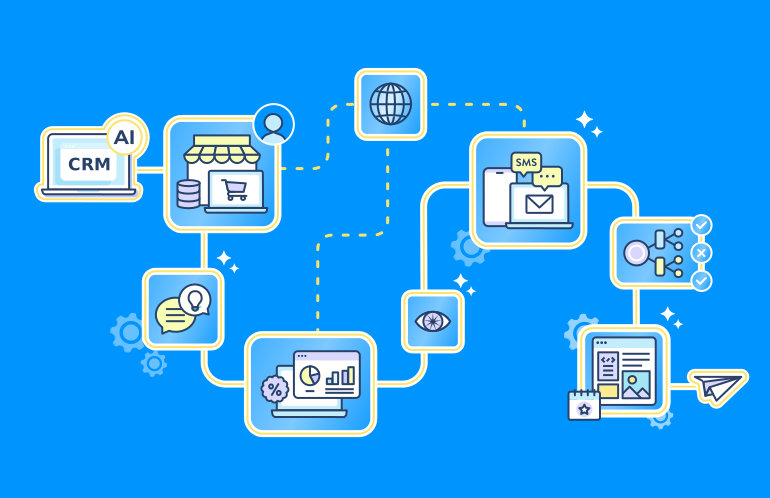
Email remains central, but it is no longer expected to handle everything. In 2026, success often hinges on a combination of email, mobile, automation, and predictive analytics—all seamlessly integrated.
Another highly actionable insight: not all peak periods are created equal. Campaigns like Black Friday and winter sales generate an average click-through rate of 1.8%. This doesn’t mean you should stop; it means these periods require even greater selectivity.
The recommendation will be to reserve mass communication for moments that truly matter to customers and bring the rest of the schedule back under control (pressure, pace, audience, value)/
If 2026 were to be summed up in a single CRM discipline, it would be this: managing pressure through expected value.
AI agents will transform the daily work of CRM managers by providing faster analytics, continuous recommendations, more nuanced decision-making, and real-time orchestration. In this context, the click will inevitably be re-evaluated and considered in the context of other signals (session quality, conversion, repeat purchases, churn, and omnichannel contribution).
But it will remain a key indicator, because it remains a universal sign of a healthy relationship. A customer who clicks is a customer who is paying attention. In an omnichannel email relationship (email + mobile + automation), the click remains a clear link between the brand’s promise and the customer’s action.
The 2026 revolution isn’t about sending messages more intelligently; it’s about embracing the simple idea that attention is a scarce resource and that CRM must manage it as such.
Fewer emails, more clicks is becoming the new standard. Predictive AI integrated into marketing automation exactly that: it delivers more relevant campaigns, reduces fatigue, and boosts CRM performance in a sustainable way.
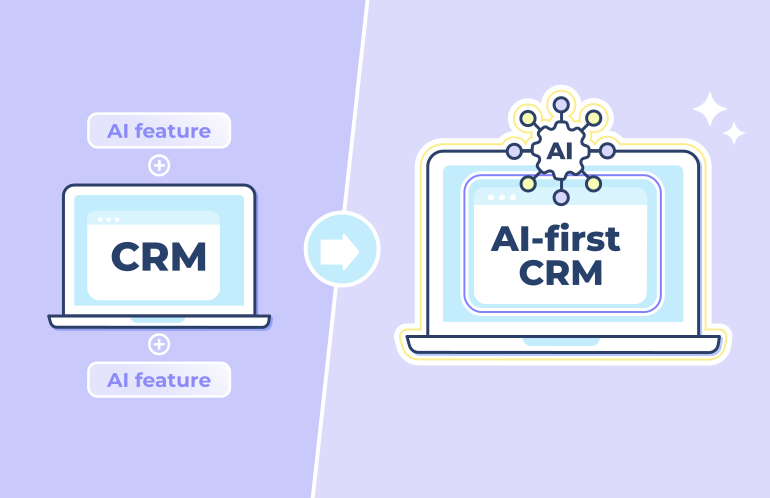
It is precisely to address this new reality that Splio has made a strategic decision: to natively integrate Tinyclues AI at the core of marketing automation. Not as a separate “side” component, nor as a tool to be connected and managed separately, but as an intelligence system directly linked to CRM data.
The goal is simple: to shift from a model where we automate email sends to one where we automate targeting decisions. In other words, to ensure that every campaign and every scenario reaches the right people at the right time, with a controlled level of engagement, in order to protect the relationship and maximize value.
Contact us to learn more about Tinyclues AI
Table of Contents