AI-First CRM: From AI as an Add-On to AI as an Integrated Feature
26
March

Sandra Fernandes
Category: AI for CRM
By 2026, CRM will no longer resemble the system we knew yesterday. The challenge is no longer simply to add artificial intelligence features, but to rethink customer relations in a digital landscape where decision-making is becoming conversational.
In this context, CRM is no longer merely a tool for marketing activation or campaign orchestration. It is becomingthe brand’sdecision-making infrastructure, managing in real time the multitude of dynamic interactions—many of which are initiated by interfaces that are no longer directly human.
Yet many organizations still treat artificial intelligence as just another feature: a few predictive models, automated workflows, or content generation.
In a rapidly evolving digital landscape, CRM can no longer simply focus on optimizing existing systems. It must be designed as an AI-first architecture capable of learning, making decisions, and operating at the heart of an agent-based ecosystem.
According to Thibault Renouf, Co-CEO of Partoo, “The advent of agent-based technology in 2026 will mark the third major revolution in e-commerce, following the rise of online shopping in 2006 and the boom in marketplaces in 2016.”
The first signs of this third revolution began to emerge in late 2022 with the rise of generative AI, marked in particular by the launch of OpenAI and its conversational AI, ChatGPT. Gradually, the web as we know it—based on search engine queries, clicking, comparison, and individual decision-making—is giving way to a conversational web.
Conversational web refers to a digital environment in which users interact with AI agents to obtain answers and recommendations or perform actions. Users no longer navigate between pages; instead, they express an intent, and systems synthesize the information to deliver a contextualized response that can be acted upon immediately.
In practical terms, consumers will no longer compare ten product pages open in different tabs. Instead, they’ll ask an AI agent: “Find me the best running shoes for a marathon in the rain.” The agent will select and compare the available options and suggest a selection.
In this new paradigm, brands are no longer discovered through exploration, but through recommendations. The chatbot acts as a decision-making filter that interprets the query, aggregates available knowledge, and provides a response. Visibility no longer depends solely on search engine rankings or paid media. Instead, it hinges on an organization’s ability to make its knowledge accessible, reliable, and actionable by AI.
For the first time, AI is acting as an active intermediary between the brand and its audience—a shift that is profoundly transforming the very nature of customer relations. As Antoine Parizot, Co-CEO of Splio, points out , “maintaining the connection between the brand and the customer is going to become a real challenge.” Indeed, as chatbots increasingly intervene in the purchasing journey, organizations risk losing control of direct interaction.
This is precisely where CRM plays a key role in fostering the relationship between the brand and the customer. The system organizes customer insights, provides agents with data, and enables the brand to remain recognizable, consistent, and relevant.
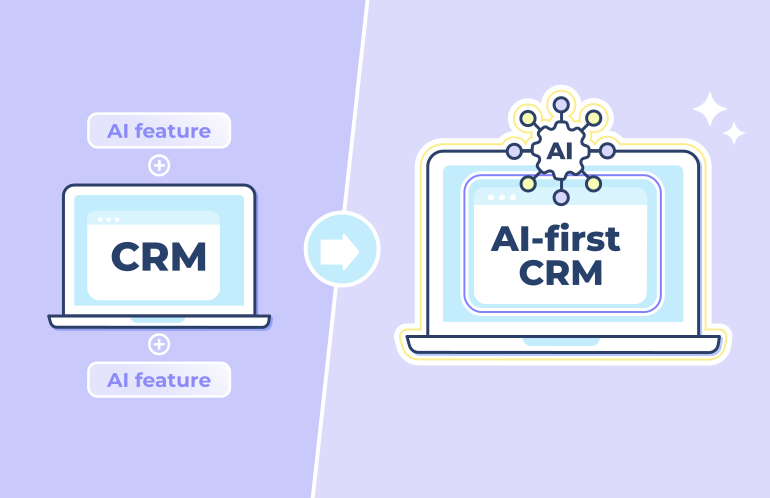
For years, CRM innovation has taken the form of successive layers of new features. AI was initially added as a module for predictive scoring, product recommendations, or optimizing campaign send times. But this additive approach has now reached its limits; we need to design a system capable of making decisions in an uncertain environment.
Decisions are now made on an ongoing basis and can no longer wait for the next monthly segment or the next scheduled campaign. Every interaction triggers real-time decision-making.
A AI-First CRM does not use artificial intelligence as an optimization tool, but integrates it as a central engine. The goal is not to automate further, but to remain relevant in a business environment where decisions are no longer always made by humans and where the quality of the relationship depends as much on data as on the ability to train the AI systems that speak on behalf of the brand.
For the 2026 CRM to evolve from a dashboard into a true decision-making hub, its architecture must be designed to:
This transformation is not merely theoretical. Splio has invested over 7 million euros in R&D to redesign its CRM system around these use cases and is already generating 30% of its revenue through AI tools by 2025. The emergence of language models and operational agents confirms that this shift is no longer a prediction: it is imminent and structural.
For CRM teams, this shift translates into very concrete changes. It is no longer just a matter of building scenarios or optimizing campaigns, but of ensuring the quality, structure, andaccessibility of customer data. CRM managers will soon need to focus just as much on knowledge governance, APIs, and data source consistency as they do on marketing segmentation. Because these are the factors that will determine agents’ ability to understand, recommend, and accurately represent the brand.
Traditional CRM is based on a consistent approach:
In the age of agent-based web, this stability is crumbling, as customer journeys are no longer linear. An abandoned scenario can become obsolete in a matter of hours if an AI agent redefines the consumer’s selection criteria. Similarly, monthly segmentation becomes useless if audiences evolve with every conversational interaction.
CRM can no longer simply orchestrate planned campaigns; it must account for unpredictability. Rethinking CRM isn’t just about modernizing an interface or increasing automation: it’s about developing a decision-making system that determines the best course of action at every moment.
This transformation shifts decision-making power to employees; we must therefore accept that decision-making will become algorithmic on a large scale. The brand must therefore ensure that its CRM is more sophisticated than the intermediation it faces.
It must also address a crucial question: What is the source of knowledge? As Antoine Parizot, Co-CEO of Splio, points out : “When answers are generated by models, the central question becomes one of truth. Who provides the knowledge used by the agents? On what data is the final recommendation based?”
The solution lies in an AI-powered CRM that organizes knowledge, trains agents, and strengthens the customer relationship. Only an AI-first CRM can help navigate this structural shift by becoming the brand’s nervous system.
Conversational web is now the norm. AI agents act as intermediaries between the brand and the customer, decision-making is decentralized, and the direct connection is becoming weaker. In this context, the question is no longer whether AI should be added to CRM—it must be at its core.
AI-powered CRM is becoming the brand’s strategic infrastructure, organizing data, guiding agents, and safeguarding customer relationships. 2026 is not just another year: it’s a window of opportunity to rethink relationship marketing and gain a competitive edge in a business environment where decisions are made through conversation and autonomy.
More than just a technological issue, it’s a matter of long-term viability: Is your CRM capable of supporting the brand in this new environment?