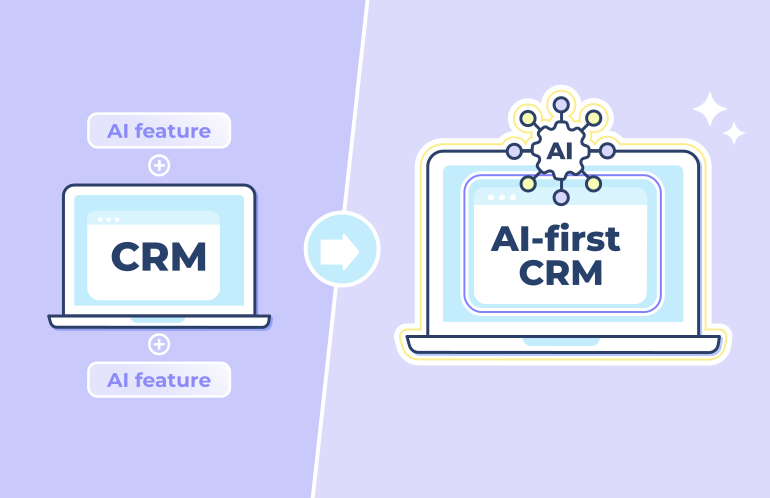
What if your CRM already knew which customers to target (and why that changes everything)?
16
April 16

Camille Macaudière
Category: AI for CRM
What if your CRM platform could select the best audience to help you achieve your business goals?
An effective CRM strategy promises to immediately capture the attention of your customer base in order to achieve your business goals.
In recent years, brands have realized the importance of collecting data on their customers. This data enables them to offer a personalized experience and tailor their content to individual preferences. This data has now reached a point where it’s becoming a bit overwhelming, as a new threshold has been crossed: that of data overload. Too much data. Not enough time (or resources) to analyze it.
This abundance leads to a fairly straightforward question: How should we prioritize customers? What customer segmentation should be implemented? Which segments should we focus on to achieve our sales goals?
By integrating predictive audiences into our marketing automation platform, we provide CRM managers with a platform that fully addresses their targeting and business challenges. In this article, we’ll explore how predictive audiences integrated into marketing automation CRM teams to improve their campaign conversion rates.
The top priority identified among CRM managers: the need for better segmentation. Not for the sake of marketing sophistication, but to address a very practical challenge: reducing marketing pressure by avoiding campaigns sent to the entire database. Due to a lack of time to build relevant segments, many teams continue to favor “full-base” approaches, at the expense of marketing pressure and overall performance.
“It’s hard to get a comprehensive view of the segments and to tailor our communications precisely,” a retailer in the fashion industry told us.
Second key finding: Customer loyalty depends above all on the ability to trigger a repeat purchase. Behind this goal lies a major challenge: recouping acquisition costs and driving growth by increasing customer lifetime value. However, identifying the right customers to engage at the right time remains complex, and the strategies implemented often lack precision or automation.
“We know that if they buy twice, they’ll stick around,” another retailer in the fashion industry confirmed to us.
CRM teams are also expressing a growing needto optimize their existing systems, particularly their automated workflows. While these processes have become essential for supporting sales goals, they are still too rarely reviewed or enhanced due to a lack of time or resources. The challenge is not to do more, but to make them more effective without increasing the workload on teams.
“Post-purchase scenarios aren’t generating enough sales,” a retailer in the beauty industry told us.
Finally, another key challenge has emerged regarding channel orchestration. While email remains by far the dominant channel, other (often more expensive) channels are still underutilized or deployed only sporadically during peak sales periods. The result: missed opportunities throughout the year. Teams express a clear need to make better use of these channels—in a more targeted and relevant way—as part of a truly managed CRM strategy.
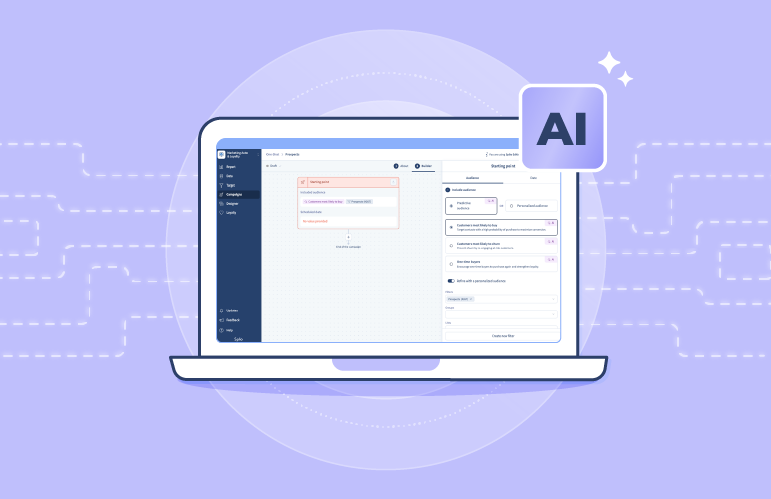
Predictive audiences help address the pain points identified among retailers. We have therefore integrated them directly into the "heart of marketing automation AI continuously analyzes customer behavior and provides three key predictive audiences that can be directly leveraged in day-to-day campaigns—all without requiring any extra effort from CRM teams.
You have thousands, or even millions, of contacts in your database. And the question every CRM manager eventually asks is this: which of these contacts are actually ready to buy when I send out my message? This question leads to another: what criteria should I use to segment effectively?
For a long time, the approach was based on relatively simple logic. Filtering by the date of the last purchase, by frequency, by product category… these are all useful rules, but they remain approximations of actual customer behavior.
The problem is that these rigid approaches capture only part of the picture. They fail to account for the multitude of weak signals that, when taken together, indicate an intention to purchase: changes in behavior, recent engagement, cross-channel interactions, and dynamics unique to each customer.
This is precisely wherepredictive AI makes all the difference. By analyzing hundreds of variables simultaneously, it can identify—in a matter of seconds—the customers most likely to make a purchase at any given moment. This is where a manual approach quickly reaches its limits.
By integrating Tinyclues AI into the core of its marketing automation platform, Splio enables CRM managers to adopt an intelligent prioritization approach:
The benefits for brands through this approach are clear: campaigns are more relevant, better targeted, and more effective. It’s an approach that’s more respectful of the audience, limiting oversaturation while maximizing the ROI of each communication. Isn’t that a form of personalization?
It’s a well-known adage in customer marketing and CRM: retaining a customer is always cheaper than acquiring a new one. Yet, when it comes to putting theory into practice, one aspect is often overlooked: the ability to trigger a repeat purchase.
This is a key issue for brands and a major growth challenge. After all, turning a first purchase into a lasting relationship is no easy feat. In reality, many CRM teams still struggle to determine who to follow up with and when. As a result, one-time buyers are often treated the same, regardless of their potential or level of engagement.
Behind this lies the same underlying issue: a lack of insight into actual customer behavior and a difficulty in identifying actionable patterns. Retargeting strategies do exist, but they often remain generic due to a lack of sufficiently detailed or actionable segmentation.
This is where the stakes become critical: without a clear understanding of weak signals, it’s difficult to build a truly effective customer retention strategy. And in this context, you tend to try more and more approaches rather than focusing on the right opportunities.
Once again, the key lies in the ability to move beyond overly rigid segmentation and adopt a more dynamic and predictive approach. The predictive audiences integrated into marketing automation platform are specifically designed to address this need by analyzing a wide range of behavioral signals to identify, among first-time buyers, those with the highest potential for a second purchase at any given time.
An approach that fundamentally changes the way we engage this type of customer:
Beyond immediate results, what is emerging above all is a new way of thinking about customer loyalty: no longer as a series of one-off campaigns, but as an ongoing strategy, data-driven and focused on the customer’s progression through their lifecycle.
In any CRM database, a significant portion of customers eventually become inactive at some point. Less engagement, fewer purchases, and increasingly infrequent interactions… a churn that is often gradual and sometimes difficult to detect in time.
For CRM teams, this raises two questions: When do we actually consider a customer to be inactive? And, more importantly, which customers are still worth reactivating?
In practice, many reactivation strategies are based on simple rules: a period of inactivity arbitrarily defined by the CRM manager, followed by a campaign sent to all affected customers. While this approach may seem effective at first glance, it quickly reveals its limitations: it fails to distinguish between customers who have been permanently lost and those who could still be re-engaged.
The result: underperforming campaigns, unnecessary marketing pressure on part of the customer base… and missed opportunities with customers who could actually be won back.
Behind this lies a well-known challenge: identifying the right signals (and distinguishing them from weak signals). Not all inactive customers are the same. Some are simply taking a break, others have changed their habits, and some will likely never return. Without making this distinction, it becomes difficult to make effective decisions.
This is precisely where predictive audiences come into play. By analyzing past behavior, engagement signals, and the unique dynamics of each customer, they make it possible to identify, among inactive customers, those who still have the potential to be reactivated.
An approach that fundamentally transforms reactivation strategies:
Beyond the performance gains, this approach above all helps restore meaning to reactivation campaigns. This is especially true when the body of the message is also personalized with the best products for each inactive profile, thanks to product recommendations.
And as with other audiences, this ability to prioritize paves the way for more refined strategies: tailoring messages, selecting the most appropriate channels, or even integrating them directly into automated workflows to engage these customers at the right moment.
Integrating predictive audiences directly into the heart of marketing automation is marketing automation merely a technological advancement. It represents a fundamental shift in how you manage your CRM strategy: it’s easier to use, faster to implement, and, above all, more effective in driving click-through and conversion rates.
It is predictive analytics that now enables CRM teams to better target their campaigns and achieve their sales goals. With these predictive audiences, Splio’s goal is clear: to help you focus on what matters most. Less complex segmentation, more relevant activation. Less volume, more impact. By automatically identifying the right customers to target, CRM becomes a true prioritization tool, directly integrated into marketing automation. You gain efficiency, and your campaigns gain performance.
But simply identifying who to target isn't enough.
But you still need to offer the right content. That’s where product recommendations integrated into your newsletters really come into their own. Combined with predictive audiences, they helpalign targeting with content: the right customers with the right products.
The result: more relevant messages, higher click-through rates, and a more consistent customer experience.
For more information, contact us !
Table of Contents